
Looking to Benchmark Pay?
Independence of committee members
The IRS rules and SEC rules (which the stock exchanges define for listed companies) should be tested to determine compensation committee independence. Membership is taken from the board of directors and chosen by the full board, by the chair of the board, or by a nominating committee. There are several types of directors:
Inside directors are employees of the company and do not serve on the audit, nominating or compensation committees due to a conflict of interest.
Outside directors were introduced as part of the requirements of IRS 162(m) for governance and management of a performance-based plan. (An independent director may also be used.) Outside directors must not be:
- a former employee of the publicly held corporation receiving compensation for prior services (other than under a tax-qualified retirement plan)
- a current employee of the publicly held corporation
- a former officer of the publicly-held corporation
- receiving remuneration, directly or indirectly, from the publicly held corporation in any capacity other than as a director, including remuneration for goods as well as services
Non-Employee directors were introduced as part of SEC Regulation S-K. The major distinction between these and an outside director is that this type of director MAY have had a relationship (e.g. employment or business) with the company, but not in the recent past. The term affiliated outside director may also be used. They also will generally not serve on audit, nominating, or compensation committees. The requirements are:
- not currently an officer or employee of the publicly held corporation or a parent or subsidiary of the publicly held corporation
- cannot receive compensation (other than as a director) in excess of the amount per SEC Regulation S-K either directly or indirectly from the company
- does not possess an interest in any other transaction for which disclosure would be required under Item SEC Regulation S-K
Lead directors are required by the NYSE and NASDAQ exchanges in companies that have CEOs that also serve as a Board Chairman. Presiding director may also be used to mean lead director. The requirements are similar to those of the outside director.
The NYSE and NASDAQ independence standards are much alike. Both exchanges set thresholds for independence tests in order to meet the standard. Some of the bright-line tests are:
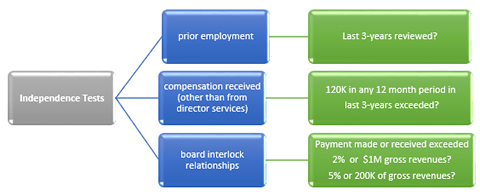
The intent is that board directors should have no material relationship with the organization directly or indirectly that may lead to a conflict of interest or undue influence. The relationships within the purview of the independence standard could be commercial, banking, consulting, accounting, legal, charitable, financial and/or familial. For mandated committees, the independence standard is more narrowly defined by prohibiting interlocking relationships between current C-suite and board directors. For example, Mark Zuckerberg, Facebook CEO, would not have passed the independence test to be a Compensation Committee member of Netflix when Reed Hastings was a director on the Facebook board and the CEO of Netflix. Members of these mandated committees must be independent.
Directors are expected to carry out their responsibilities fostering arm's length transactions without impinging fiduciary, governance, and oversight requirements inherent in their roles. The board directors and the C-suite employees play an integral part in maintaining independence standards which require self-reporting and appropriate disclosures of the parties involved. On an ad hoc basis, a director can recuse themselves from a meeting if a possible conflict of interest arises. Controlled companies (e.g., those considered closely held or having a 50% plus voting power by a single entity) have less restrictive independence requirements, and newly listed companies are afforded a phased in approach to meeting the standards.
Memory Jogger
Which of the following would NOT be considered an affiliated outside director?