
Looking to Benchmark Pay?
Pay grades and ranges
Ideally, geographic salary structures will provide grading consistency with comparable jobs at the organization's headquarters. The salary grades will ensure company-wide consistency and become an important tool to manage internal equity throughout a business.
| Salary grades | Groupings of jobs of the same or similar value, used for compensation purposes. The groupings typically appear on the horizontal axis of the salary structure and help to support internal equity within an organization. These represent the organization’s valuation of the jobs within a salary structure. |
|---|
Q: What is the effect of a branch pay line that differs from headquarters?
A: The salary grades help to support internal equity within a business. Some companies will manage short- and long-term incentive eligibility and sometimes even benefits or perquisites based on grades. The branch pay line should represent the competitive marketplace for the branch office.
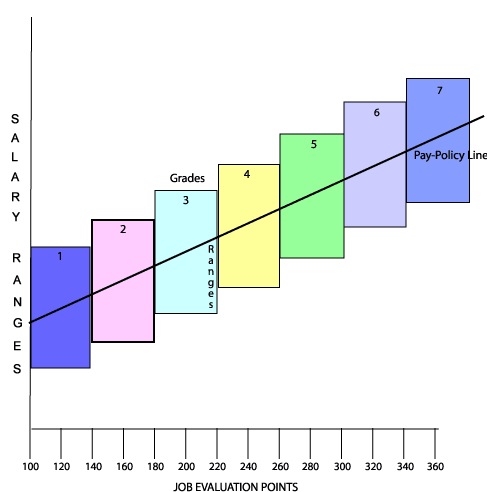
| Salary ranges | The minimum, midpoint, and maximum that can be paid an employee whose job falls within a particular salary grade. |
|---|
If you raise the pay-policy line of a branch office, this will then raise the salary range for each grade.
Now there will be different:
- minimums
- midpoints
- maximums
If the pay-policy line rises or falls at the same slope, then each pay grade changes the same percentage. This is the ideal approach when managing geographic pay.
Q: What will change when there's a change in the slope ofthe pay-policy line?
A: The amount of overlap between salary grades. Caution should be exercised when changing the slope of a pay policy line. A headquarters salary structure will have many more benchmark jobs used in the analysis. A branch office salary structure with a limited number of benchmark jobs may produce a different slope but may not be the desired outcome.
Except for the minimum of the lowest grade and the maximum of the highest grade, there should always be an overlap in pay between adjacent salary grades. So, an employee at the top of a lower grade will earn more than an employee at the bottom of (or even up to the midpoint of) the next higher grade.
This overlap:
- decreases when the slope is steeper
- AND
- increases when the slope is flatter
Memory Jogger
A salary range is the: