
Looking to Benchmark Pay?
CALCULATING A GEOGRAPHIC SALARY STRUCTURE AS A PERCENT OF HEADQUARTERS' SALARY STRUCTURE
More and more companies are calculating their geographic salary structures as a percentage of the headquarters' salary structure. This provides simplicity to the process especially when their headquarters represents all functional disciplines, and the business operates throughout the United States within one industry.
The following is an extensive example of assessing a geographic salary structure comparing a state, regional, and city approach.
Hypothetical Company Example
Let's review a hypothetical example of a company headquartered in Denver, Colorado, with Customer Service offices in the following locations:
| City | State |
|---|---|
| Montgomery | Alabama |
| Los Angeles | California |
| Red Bluff | California |
| San Francisco | California |
| San Jose | California |
| Denver | Colorado (HQ) |
| Chicago-Lincoln Park | Illinois |
| Baton Rouge | Louisiana |
| Missoula | Montana |
| New York-Manhattan | New York |
| Columbus | Ohio |
| Nashville | Tennessee |
| Tyler | Texas |
| Superior | Wisconsin |
| Bellevue | Washington |
For the purposes of this example, we have used data from ERI's Salary Assessor® and the market median of a Customer Service Representative (General Calls) for All Industries to determine the base salary difference by geographic location.
STATE APPROACH
Let's look at how the median annual base salary of a Customer Service Representative (General Calls) varies by state. In this example, we are comparing our headquarters location (Colorado) to each state in the United States. (As an alternative, we could use the United States national market data in lieu of the headquarters' location.)
As a first point of review, we can calculate the percent difference of the median salary for the Customer Service Representative for each state as compared to the Colorado state market median. Based on 50 states and the District of Columbia, there are 25 different median market pay rates for the Customer Service Representative when compared to the headquarters pay by state, with a low of 82% in Mississippi and a high of 114% in the District of Columbia. This is overly complex for a geographic pay program and can be simplified by rounding the differentials to the nearest 10%. (Rates below 5% may be too small to recognize.) This then creates just four different geographic rates throughout the United States for the Customer Service Representative, which may be more appropriate.
Although the Geographic Salary Structure by state will work, there are some items worthy of consideration:
- Differences by state combine many metropolitan, suburban, and rural marketplaces. For example, California has markets ranging from high-priced San Francisco and Silicon Valley to Los Angeles, Fresno, Bakersfield, and the even lower-priced Red Bluff and other similar lower-priced markets.
- The geographic salary structure by state does not sufficiently recognize hot job markets.
- The geographic salary structure by state can inflate compensation for lower-priced, small cities and rural markets.
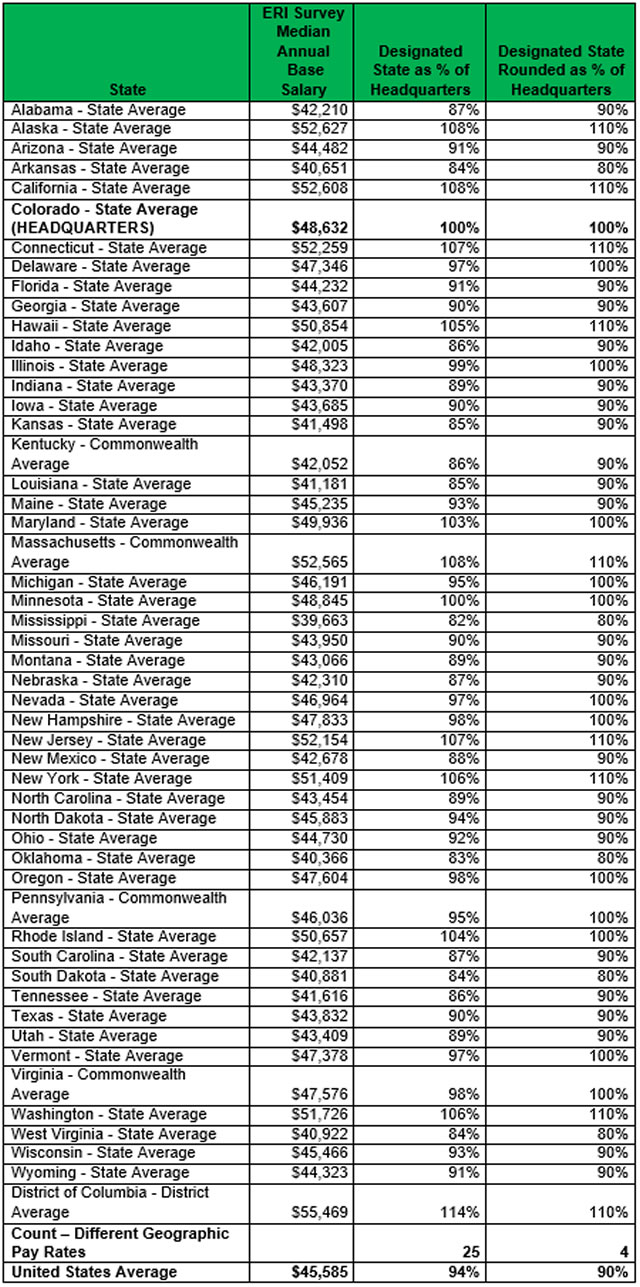
Source: ERI's Salary Assessor - Customer Service Representative (General Calls).
All numbers are for illustration only.
REGION APPROACH
A regional approach provides simplicity in the process of managing a geographic pay program, although this benefit may be outweighed by the number of issues it creates. Similar to the state approach, large metropolitan areas are combined with very small cities and rural markets, often resulting in pay that is too high for some locations and too low for others as compared to their cost of labor marketplaces.
One of the challenges under a regional approach is to create appropriate regional breakouts that reflect differences in the competitive marketplace. In general, the cost of labor is highest in the Northeast and West Coast, and lowest in the Southeast.
Consider these examples:
West Coast
Mountain States
Midwest
Southeast
Southwest
Northeast
Great Plains
For a regional approach to work for the hypothetical company, it would be necessary to break out high-cost locations even further, such as creating geographic breakouts for the following metropolitan areas:
San Francisco Bay Area
Greater Los Angeles
Seattle/Bellevue
New York City
The inconsistency between the regional and metropolitan approach creates additional complexities in the geographic pay program for our hypothetical company. These inconsistencies create the need for exceptions to the program, leading to additional requests for other metropolitan markets to be recognized.
CITY APPROACH
A city-specific salary structure can work very effectively for a business with a limited number of offices within a country. However, there are also ways to obtain the best of a city-specific structure for businesses with many business locations in a country.
The vast majority of geographic pay rates by job throughout the United States do not vary by more than 50% from the lowest paid to highest paid locations. An effective way to manage city-specific pay rates is by applying a standardized formula to a geographic structure, as in the following example:
| Cost of Labor by City | Geographic Salary Structure |
|---|---|
| Very high markets | 120% |
| High markets | 110% |
| HQ or national marketplace | 100% |
| Low markets | 90% |
| Very low markets (optional) | 80% |
A city-specific approach recognizes unique pay rates in very hot markets while not overpaying in marketplaces with lower costs of labor.
Memory Jogger
Which geographic pay approach recognizes unique pay rates in very hot markets but does not overpay in marketplaces with lower costs of labor?