
Looking to Benchmark Pay?
City - Job Market Pricing Approach
Applying this methodology to our hypothetical company, the Customer Service Representative (General Calls) is market priced for each city with an office location. Utilizing five different geographic salary structures from 80% to 120% ensures a simplified program.
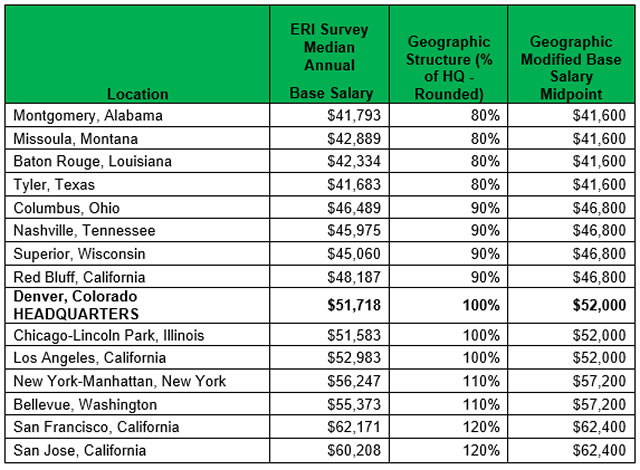
Source: ERI's Salary Assessor - Customer Service Representative (General Calls).
All numbers are for illustration only.
The state approach pays all employees working in California at 110% of the salary structure at the headquarters location in Denver. Alternatively, the city approach appropriately recognizes the high-priced San Francisco and Silicon Valley marketplaces with a 120% premium, while not overpaying a lower cost of labor city such as Red Bluff, California, which is valued at 90% of the Denver marketplace.
City – Cost of Labor Approach
Another option is to apply a cost of labor approach. ERI Economic Research Institute's Geographic Assessor® provides a robust tool to assess cost of labor by geographic location. This provides a simplified approach to utilizing the cost of labor to calculate geographic differentials and salary structures, as well as ongoing maintenance of the program.
The cost of labor, $51,718, for a Customer Service Representative (General Calls) at the Denver, Colorado, headquarters is used as the basis of comparison with the cost of labor for each city where our company has office locations. Cost of labor does not identify the cost of a specific job, such as Customer Service Representative (General Calls). It only uses a provided salary, which may be for a specific job, but also includes all other jobs paid at that level.
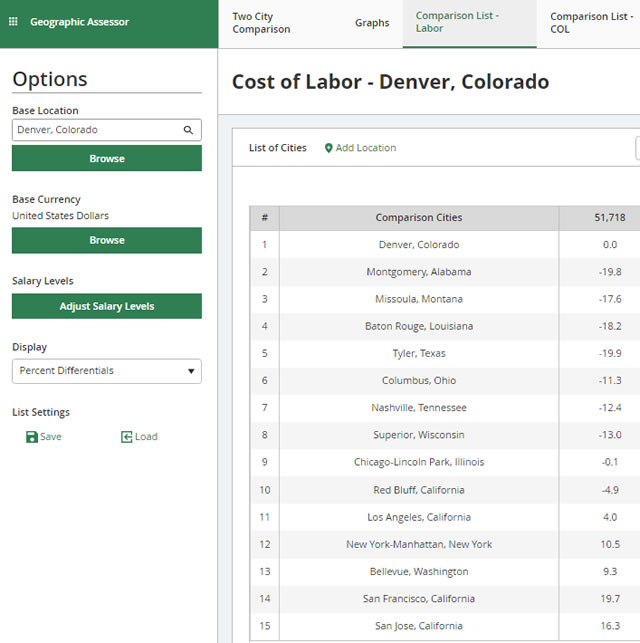
Source: ERI's Geographic Assessor. All numbers are for illustration only.
Cost of Living Versus Cost of Labor
The Cost of Living is determined by the supply and demand for expenditures in a location, including consumables, transportation, health services, housing, and taxes paid by an employee. The Cost of Labor is determined by the supply and demand of labor across all industries and occupations by location. Cost of Labor represents differences in market rates of all jobs combined in each local labor market.
Where cost of living is very valuable in managing relocations and temporary assignments, cost of labor is most valuable in managing ongoing, regular assignments. This includes developing salary structures, managing geographic pay, and assessing the cost of doing business in a particular location.
For these reasons, the cost of labor approach is used to assess geographic compensation.
Comparison of Market Approach to Cost of Labor Approach
When comparing the city market pricing approach to the city cost of labor approach, 1 of the 15 city locations for our hypothetical company comes out differently (Red Bluff, California). The reason for the difference is that the Salary Assessor is pricing one specific job for the hypothetical company, whereas the Geographic Assessor is pricing all jobs combined under the cost of labor approach.
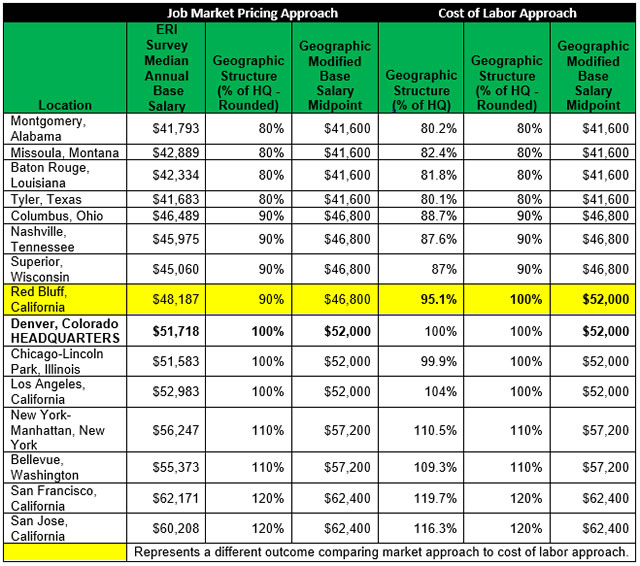
Source: ERI's Geographic Assessor and Salary Assessor - Customer Service Representative
(General Calls).
All numbers are for illustration only.
Why Geographic Pay Differentials?
Is it advantageous for an organization to implement geographic pay differentials using cost of labor or a geographic salary structure that market prices jobs? A geographic pay differential will add or decrease a specific amount to an employees' pay due to differences in the local labor market and will minimize employee relations issues caused by unjustifiable differences in geographic pay rates, especially as a result of employee relocation.
Which Geographic Salary Structure Approach is Preferred?
There are four options to consider when determining which approach is preferred:
- State
- Region
- City - Market Pricing
- City - Cost of Labor
The city approach, with five tiers of cost of labor (ranging from 80% to 120%) compared to the headquarters salary structure (100%), is our preferred approach for recognizing differences in geographic pay. This approach is market competitive and responsive to pay equity laws. (Keep in mind some states require pay equity by county, so review to ensure compliance.) It also ensures simplicity in the maintenance of the overall salary structure, allowing the hypothetical company to recognize important geographical differences in pay.
The cost of labor approach for our company is the preferred method to calculate geographic structures because fewer steps are needed. It eliminates individual pricing of each job within each city and ensures that the cost of labor calculation can be applied to the entire headquarters' salary structure. This not only provides simplified ongoing maintenance of the program but also consistency for all jobs within a geographic location.
Customer Service Representatives (General Calls) in our company's customer service locations would then be managed to the following salary structure:
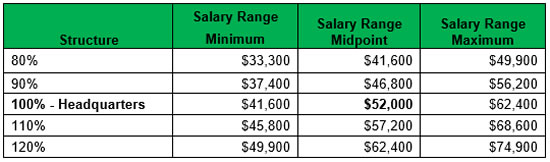
Customer Service Representative (General Calls)
This formula approach can also easily be applied to an entire salary structure in the hypothetical company.
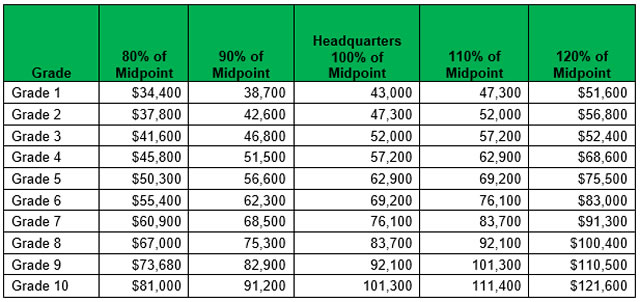
Customer Service Representative (General Calls)
You can see that a geographic salary structure doesn't have to be overly complicated. A geographic salary structure such as this basically takes the headquarters' salary structure and applies it to the local market value of jobs in a very fair and equitable way.
Memory Jogger
Which would not be an appropriate approach for calculating a geographic salary structure?