
Looking to Benchmark Pay?
THE TOTAL COMPENSATION PACKAGE
Now that we've looked at types of management jobs, we'll examine their compensation packages.
These packages have a number of components:
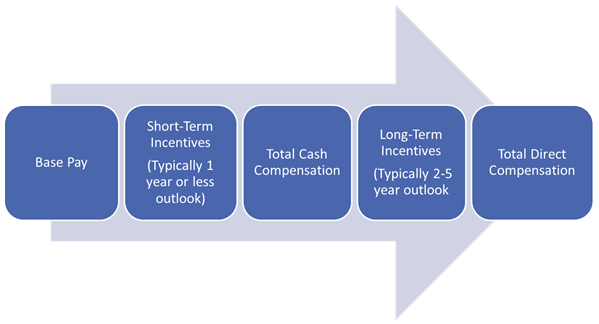
Benefits (statutory and non-statutory) and perquisites should also be considered when designing the overall Total Rewards program.
Key constructs to effectively design and manage the total compensation package are:
-
Compensation mix
- Fixed pay vs. variable pay
- Short-term pay components vs. long-term pay components
-
Leverage
- Level of up-side potential in variable pay and long-term pay components
Base Salary
The percentage of total compensation that base salary, or fixed pay, represents depends on the level of the job in the organization's hierarchy. Generally, the percentage is negatively correlated with progression along the career path. First-line managers' base salary typically represents 80%-90% of their total compensation, middle managers' base salaries are 40-80% of their total compensation, and top-level managers' base salaries are 20%-40% of their total compensation, respectively.
The higher the management level, the lower the percentage of total pay is represented by base salary.
Base salaries are determined by both internal and external factors. These factors include:
- compensation strategy
- job content
- job evaluation
- market pricing
- organization size
- geography
- industry/competitors
- salary structure
- organizational performance
- employee performance
- culture
Industry and revenue are the most common components used to measure jobs in external salary surveys.
Compensation strategy. A compensation strategy will determine the overall compensation direction for an organization, or an employee group, as compared to the external labor market.
Job content. Job analysis and job documentation are considered to be the foundation of every compensation plan. Accurate job documentation is critical to ensure a fair and equitable hierarchy of jobs as well as appropriate market pricing to develop a competitive compensation program.
Job evaluation. Jobs may be evaluated based on internal equity or through external market pricing. Job ranking, job classification, factor comparison, point factor and external market pricing are common types of job evaluation plans for both management and non-management jobs. Some pay equity laws require job evaluations based on skill, effort, responsibilities, and working conditions, suggesting a point factor methodology be used for job evaluation. The Korn Ferry Hay Group job evaluation program and Aon’s Job Link are examples of point factor job evaluation programs. (There is a demonstration on how to do point factor job evaluation in DLC Course 34: Using Job Evaluation in Your Organization.) Most companies will use external market pricing to evaluate their jobs.
Market pricing. Market pricing is the process by which the value of each benchmark job in an organization is determined through the analysis of the external marketplace as typically reported through salary surveys. This is the most common of all job evaluation methodologies. Of the companies that market price their jobs, 60% design their programs with one range per grade, but the other 40% use multiple ranges within grades or “pure market pricing.” This can be a valuable methodology for pricing management jobs.
Organization size. The basis for determining top management pay is frequently defined by annual revenue. Other factors include market capitalization, the asset size of the enterprise, budget, or the number of employees. These define the “scope” of the position.
Geography. Is there a national, regional or local market for management talent? The answer is that typically, the more senior the position, the broader the definition of the geography.
Industry practices. Industry differentials have long been utilized to assist in explaining executive compensation. Higher margin firms typically need less revenue to generate higher compensation values for their management. Low margin enterprises (grocery stores, for example) need larger revenue amounts.
Salary structure. First-line and middle-management pay criteria are more likely to be influenced by internal organizational factors. The top management’s pay is a ceiling in the organization, and all other managerial positions can be compared as a percentage of that position's pay. Larger organizations tend to have more levels of middle management, as do those where professionals or unions are empowered and involved in management.
Organizational performance. Specific organizational measures are more often incorporated within incentive pay programs than within base pay programs. Some common measures for organization performance include:
- Revenue/Revenue Growth
- Operating Income, Net Income
- Cash Flow, Expenses
- New Sales, Strategic Goals
- EBIT, EBITDA
- Absolute or Relative TSR
- EPS
- Turnover of assets, capital, inventory
- ROC,ROE,ROIC, ROI, ROS, ROA
- Margins: Net Profit, Operating Profit, Gross Profit, Profit per Employee
- Economic Profit/Economic Value Added
- Customer Service/Satisfaction
- Product Development/R&D
- Quality/Continuous Improvement
- Employee Engagement
- Leadership Development/Retention
Employee performance/merit. How a base salary gets adjusted for current employees is typically determined by individual results/effort.
Culture. Is innovation and risk taking valued? Does the company have a "Pay-for-Performance" culture? The company’s compensation program must support the corporate culture and it must be driven by the top management in order to drive the objectives of the organization. Compensation is interwoven into the core of a company’s culture and has many touch points across the enterprise.
Memory Jogger
Top management are often paid base salaries that are ____ than their incentives and other pay.