Job leveling is a system used by HR and compensation professionals to clearly describe job roles and functions, while also establishing a structured framework to scale and categorize jobs into job families or hierarchies within an organization. Differing from job classification, job leveling seeks to classify and assign job titles into a structured framework that clearly defines the career pathway for a particular profession, as in the Software Engineering career pathway provided as an example below.
Because a job leveling system helps to frame jobs within levels of relative value, complexity, and authority, it allows HR and compensation professionals to develop clear and transparent pathways for professional development and career progression. This aspect of job leveling is important to both employers and employees as it has become a strategic tool to motivate and retain long-term employees and allows employees to understand how their roles fit within the scope of the organization.
What Makes Job Leveling Important?
Job leveling is a working framework or system that enables both employers and employees to see how specific jobs relate to one another in terms of ranking and professional development. Since jobs are classified into clear levels, each level has a set of criteria that determines how a job fits into a particular job level, which is usually based on a number of factors, such as key skills, responsibilities, and compensation.
As part of an organization’s greater compensation strategy, HR and compensation professionals use a job leveling system to provide a clear structure for a specific job’s role, responsibilities, and expectations, while ensuring fair and consistent compensation across all levels. Job leveling is an essential aspect of compensation management as it presents a framework for organizations to make transparent and equitable decisions regarding different job titles. In turn, it also allows employees to better understand their roles and responsibilities in an organization and how they can make a lasting impact in their roles as they progress.
The Benefits of Job Leveling
A job leveling system is one of the core foundations of an organization’s greater job architecture. When job leveling systems are fully developed, HR and compensation professionals can properly build out teams and manage talent. Moreover, employees can identify the skills and knowledge that are needed to progress to the next level in their careers. Here are some benefits of job leveling for employers and employees:
Benefits for Employers
- Organizational Consistency: Job leveling creates a consistent framework for roles and responsibilities across the organization, allowing managers and employees to better understand them and how different roles relate to one another.
- Enhanced Talent Management and Recruitment: Job leveling facilitates better talent management and streamlines recruitment processes by identifying and attracting qualified employees or candidates and establishing clear job descriptions and levels.
- Performance Management: With well-defined job levels, organizations can facilitate more effective review processes by providing clear expectations and feedback.
Benefits for Employees
- Fair and Equitable Compensation: Working from a job leveling framework ensures that employees are compensated fairly based on the complexity and responsibilities of their roles, minimizing pay disparities while promoting pay transparency.
- Defined Expectations: Through job leveling, job roles and responsibilities are thoroughly and clearly defined, maintaining transparency regarding company expectations and how employee performance will be evaluated.
- Clear Career Pathways and Advancement: Job leveling provides a comprehensive pathway for career advancement and explains how different roles are structured. Additionally, employees are able to understand and track advancement opportunities and stay motivated to work.
Implementing a Job Leveling System
Creating an effective job leveling system requires that HR and compensation professionals consider the goals and trajectory of the organization. Similar to setting up other organizational frameworks, a job leveling system involves multiple factors:
- Evaluate the current market and your organization. The very first thing that HR teams should do is consider the current market and how particular practices will influence and inform the job leveling framework. When evaluating current market practices, recognize that your team will be recruiting from competing organizations, so identify common job levels and career paths that are effective in attracting and retaining talented employees. By doing this, your team will be able to build an effective and data-driven job leveling system that meets current market trends and expectations, ensuring your organization stays competitive.
- Conduct a job analysis. This next step is the most critical—conducting a job analysis. A job analysis entails collection information for a specific job, such as the job description, roles, responsibilities, and salary. The key is to gather as much information on different job titles as possible and stay organized. To help with this process, HR and compensation analysts can turn to ERI’s Occupational Assessor to complete a job analysis using the Position Analysis Questionnaire (PAQ), a structured job analysis questionnaire that aids the user in conducting a quantified analysis of a given job. The questionnaire can be used to complete several crucial tasks:
-
- Determining the hierarchy of jobs and suggesting pay structures
-
- Identifying the important dimensions of each job
-
- Establishing content validity requirements of jobs
-
- Evaluation and classifying jobs
-
- Developing dimensions for appraising job performance
-
- Grouping jobs into job families/career ladders
The PAQ Analysis module in ERI’s Occupational Assessor also includes a PAQ Library to store your PAQ analyses online securely and export a variety of related reports, as well as an array of resources to guide your job analysis process. Using the PAQ, HR and compensation analysts can easily and accurately conduct a job analysis of any job, allowing them to set the foundation for a working job leveling system.
3. Consider the key criteria that will be used to evaluate and assign jobs into levels. After conducting a thorough job analysis, use your findings to identify the key criteria that will be used to evaluate and differentiate jobs amongst your job levels. Consider the complexity and value of each job, whether each level requires particular skills or certifications, how they will be measured, and how each job fits into the greater job architecture.
For this step, utilize ERI’s Assessor Platform to gain access to relevant and current job-related information on more than 18,600 job titles in more than 1,100 industries. In your account, you will be able to import and manage a comprehensive list of internal jobs, customize job descriptions and responsibilities, and add skills and certifications as they relate to that specific job.
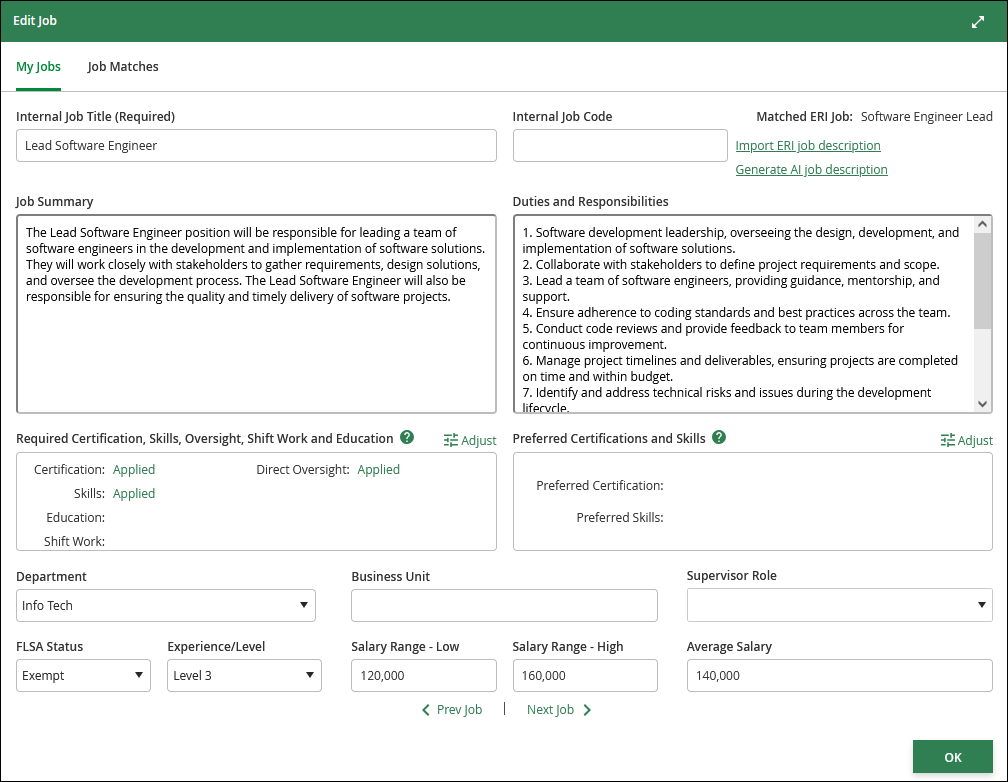
Figure 1. Using the My Organizations solution in ERI’s Assessor Platform, subscribers can import customizable internal job titles, create AI-generated job descriptions, and apply specific experience levels and salary ranges.
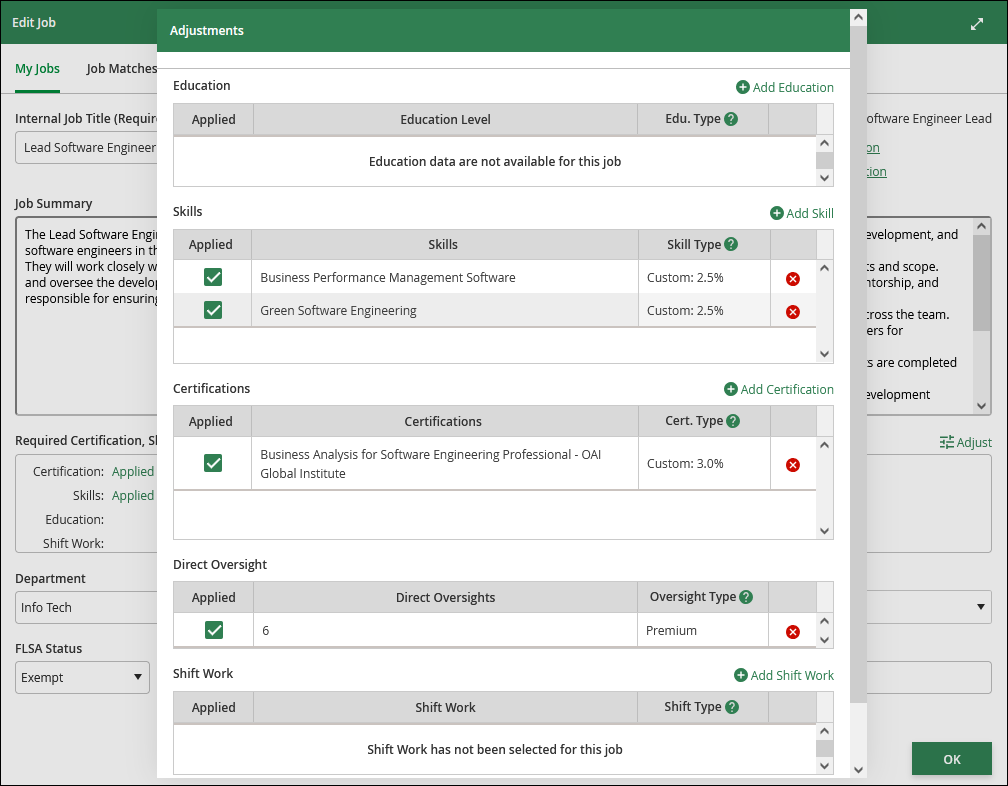
Figure 2. Using the Adjustments feature, subscribers can apply pay premiums for education, skills, certifications, direct oversight, and shift work.
Using ERI’s Assessor Platform, building out a job leveling system is straightforward. Our platform will help you plan job levels, differentiate between job titles, and inform your next steps.
4. Structure your job levels. Now, you want to begin building out your job levels. Make sure each level reflects the complexity and value of the various jobs in your organization, labeling each level to represent the different levels of jobs and roles. For example, you could utilize a common, numerical labeling system with “Level 1” representing entry roles, and “Level 3” representing the more senior roles within the framework.
5. Assign jobs to the levels. With the job levels established, your team can now assign each job to a level, utilizing key criteria that you have identified and carefully evaluating every job to ensure that each assignment stays consistent and makes sense within the company’s greater job architecture. In this step, make sure to compare jobs against one another so that you can determine the complexity of each job in relation to another.
Below, you will find an example of a job leveling framework (also known as a job leveling matrix) for the Software Engineering career pathway.
Level 1: Entry-level Software Engineer |
Collaborates with senior leaders and other product team members to develop applications to enhance productivity and to create secure, reliable, and scalable software solutions within the Software Department and in all other related departments.
|
Level 2: Software Engineer |
Develops, researches, designs, implements, tests, and evaluates software and systems, in conjunction with hardware product development, that enables computers to perform their applications, applying principles and techniques of computer science, engineering, and mathematical analysis.
|
Level 3: Lead Software Engineer |
Responsible for leading the design, development, and implementation of software solutions within the organization. This role involves collaborating with cross-functional teams to enhance and maintain the company’s software systems. Strong problem-solving skills and technical expertise are essential for success in this role.
|
Level 4: Principal Software Engineer |
Manages all phases of technical engineering projects for an organization, provides guidance to the engineering teams working on the project, and assures the successful achievement of project goals.
|
Figure 3. Example of a job leveling framework for the Software Engineering career path
Job Leveling Best Practices
It is important for HR teams to recognize that each organization requires a unique and customized job leveling system. After carefully constructing your organization’s job leveling system, consider these best practices to guarantee it stays effective and competitive:
- Ensure that each level is clearly defined. When each level in your job leveling framework is clearly defined, it presents each step transparently, especially for employees who are interested in progressing in their careers.
- Consistently update and communicate your job leveling system to employees. It is typical for job roles to adapt with organizational changes. This makes it important to consistently update your system, from the essential job description to how the role fits in the evolving organization. These updates could ultimately impact how each job is ranked or even influence pay grades. It is also essential to communicate these structural changes to employees so they are able to keep track of their career pathways.
- Consider each job individually. Treat each job with equal value when conducting a job analysis and assigning it to a job level. You will be able to gain a holistic perspective of each job and how it individually impacts the organization.
Use ERI’s Assessor Platform to Build Your Job Leveling System
Implementing a job leveling system in your organization is essential in attracting and retaining top talent. An effective job leveling system will contribute to successful recruitment of new candidates while ensuring that job descriptions and job hierarchies stay consistent across the organization. This is where ERI’s Assessor Platform comes in to streamline your process, keeping track of your organization’s job titles, compensation plan, and more. Master compensation management with ERI, and it will soon become an essential platform in your organization. Contact us for a free demo today!