HR and compensation analysts in particular industry sectors often utilize shift differentials as part of a greater compensation strategy to manage highly complex workforces, support operations, and incentivize employees. In certain sectors, such as health care, manufacturing, and logistics, shift differentials remain a core compensation practice utilized by organizations to compensate workers who take on necessary – but undesirable – shifts.
These industry sectors often navigate unique circumstances that require organizations to respond to critical staffing challenges, such as issues with retention, in addition to a highly competitive labor market. For instance, the COVID-19 pandemic increased demands on health care workers, which later contributed to a shortage of workers across all regions in the United States. Moreover, as reported in a study conducted in 2023, 91.1% of nurses experienced high levels of burnout, with 61% of nurses experiencing low levels of satisfaction.1
Statistics like these make shift differentials a necessary compensation practice in industries that must rely on continuous operational hours.
What Makes Shift Differentials a Strategic Tool in Compensation Management?
Since 2023, the health care sector has experienced a resurgence in employment, with a steady increase in employment for most of 2025.2 Despite this, employee retention remains a critical concern, making shift differential pay premiums a strategic tool to attract and retain the talent needed for staffing 24/7 operations.
Other industry sectors experience similar staffing concerns to those in health care. The manufacturing sector, for instance, continues to rely on shift differentials to cover its 24/7 production and warehouse operations. As the manufacturing industry sector faces challenges related to global competition and supply chain changes, organizations must turn to effective compensation strategies, such as incorporating shift differentials in addition to attractive pay and benefits, to retain high-performing employees.
What makes shift differentials such an essential aspect of an effective HR and compensation strategy is that they are used by organizations as a type of pay premium, typically given to hourly employees, in order to compensate them for work hours that fall within a designated time window, usually outside the regular hours, such as a “second” or “third” shift. Shift differentials are typically paid as a premium, in addition to the nonexempt employee’s hourly rate, for the entire period that an employee is working on that particular shift. Differential pay is commonly used when the shift being worked is considered a hardship, or if competing companies offer similar compensation.
The Benefits of Using Shift Differentials
In part, integrating shift differentials into an organization’s compensation strategy works to entice prospective employees to jobs that entail hours outside of what is considered a “normal” workday. Organizations stand to gain several benefits from implementing shift pay:
- Improved staffing and coverage: Incorporating shift differentials in an organization’s compensation model will improve employee turnover rates, reducing the need to stretch the workforce to compensate for a labor shortage or continuous recruitment and training of new employees.
- Maintain operational hours: Many organizations require continuous, sometimes 24/7 operations. For example, some organizations work on an international scope, with customers expecting services around the clock due to time differences. Shift differentials facilitate staffing organizations with continuous operational hours, ensuring that customer expectations are met.
- Enhanced employee retention and motivation: Burnout is prevalent across myriad industries, including the health care sector. Implementing shift differentials is an effective way to maintain continuous 24/7 care for patients while providing nurses and other health care workers with supplemental compensation for additional work hours in strenuous roles.
Incorporating shift differential pay practices has proven to be an essential aspect of compensation models in an array of industry sectors, offering HR and compensation professionals an effective way to create more attractive compensation packages. Understanding how to calculate and when to implement shift differentials is vital to a successful compensation strategy.
Best Practices: Using Shift Differentials to Stay Competitive
Meeting industry demands alongside employee expectations is a challenge in compensation management. Incorporating shift differentials into an organization’s compensation model can be an effective strategy, but it is crucial to not only accurately calculate shift differentials but also understand how to effectively implement them. Here are a few best practices to bear in mind:
Define Your Organization’s Pay Policy Clearly
Understanding your organization’s policies for compensation and pay premiums, in particular, is one of the first steps to the successful administration of shift differentials. In addition, HR and compensation professionals must pay close attention to legal requirements, such as ensuring that pay adjustments are compliant with FLSA standards.3 After gaining familiarity with these policies and requirements, it is important to carefully define the criteria for shift differential pay:
- Specify which shifts (e.g., day, night, or swing shifts), locations, and job functions or levels of responsibility qualify for the differential.
- Decide whether to offer a percentage increase or a flat-rate dollar amount for each qualifying shift.
- Apply the policy consistently across all eligible employees to avoid discrimination or favoritism.
Use ERI’s Assessor Platform to Manage Shift Differentials
After you have clearly defined the parameters for these pay adjustments, administering shift differentials becomes easier, with less room for error, when you tap into ERI’s Assessor Platform. ERI’s platform houses the benchmarked survey data that you need to apply data-driven shift differential pay and essential software to support, administer, and track these changes. ERI is the solution to all your compensation needs, allowing your team to implement effective pay adjustments, such as shift differential, as well as pay premiums for education, skills, and certifications.
Using ERI’s robust salary survey database and Compensation Management platform, HR professionals can easily evaluate and administer shift differential pay, including these steps:
- Gather the benchmarked survey data needed to ensure that the shift differentials being considered are competitive in a specific industry.
- Compare internal pay with ERI’s benchmarked survey data, with shift work premiums applied, to justify (or change) rates.
- Account for specific shift differentials while managing an organization’s overall compensation plan. In ERI’s Salary Assessor, the shift work adjustment feature allows the user to easily apply a day, night, or swing shift differential to the selected job.
- Customize and apply percentage increases for selected shift types. Depending on the shift type associated with the selected job, there may be no increase in compensation, a salary increase based on ERI’s research, or a custom hourly adjustment assigned by the user. After selecting a day, night, or swing shift differential, the user can evaluate the assigned adjustment associated with the shift work for the selected job:
No change: ERI data shows no compensation difference for this shift. This means that applying this shift does not increase the salary.
Premium: ERI data indicates a compensation increase for this shift. However, the salary increase is predefined and not customizable.
Custom: This shift type is not linked to the selected job in ERI data. Users can add this shift manually and set a custom hourly adjustment.
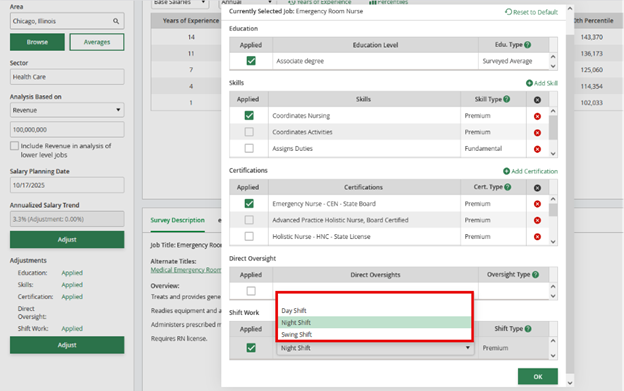
Figure 1. Users can easily select the desired shift adjustment in ERI’s Salary Assessor.
Communicate Adjustments Effectively
Upon administering these pay changes, HR and compensation teams must communicate these adjustments effectively by not only working with department leaders, but also transparently circulating these adjustments. When doing so, it important to follow these best practices:
- Make the policy readily available in the employee handbook or company intranet.
- Ensure employees understand which shifts are eligible, how differentials are calculated, and how they will appear on their paychecks.
- Provide comprehensive training for managers so that they can accurately schedule shifts and approve timecards in line with the policy.
It is also good practice to review and update premiums at least annually with a market review to ensure that salary adjustments remain competitive and fair.
ERI Is Your Data-Driven Compensation Management Solution
ERI provides the trusted Compensation Management solution that companies in today’s competitive market need to design and manage complex plans. Our Assessor Platform houses a robust salary survey database, continuously updated to ensure that organizations have access to the most current and accurate data available for an array of job titles, locations, and industries. HR and compensation professionals can easily customize the platform to meet their organization’s goals, drilling down on the data and features needed for success. Get access to reliable, benchmarked salary survey data and make data-driven decisions for effective compensation management, all in one platform.
Are you ready to start managing compensation using ERI’s innovative platform? Try a free demo to begin your journey with ERI today.
Sources:
- Galanis, Petros et al. “Increased Job Burnout and Reduced Job Satisfaction for Nurses Compared to Other Healthcare Workers after the COVID-19 Pandemic.” Nursing reports (Pavia, Italy) vol. 13,3 1090-1100. 14 Aug. 2023, doi:10.3390/nursrep13030095. https://pmc.ncbi.nlm.nih.gov/articles/PMC10443294/. Accessed 6 Oct, 2025.
- “Employment Situation Summary.” U.S. Bureau of Labor and Statistics, 5 Sep, 2025. https://www.bls.gov/news.release/empsit.nr0.htm. Accessed. 6 Oct, 2025.
- “Fact Sheet #23: Overtime Pay Requirements of the FLSA.” U.S. Department of Labor. Rev. Oct, 2019. https://www.dol.gov/agencies/whd/fact-sheets/23-flsa-overtime-pay. Accessed 6 Oct, 2025.