Looking to Benchmark Pay?
LOCAL NATIONALS
Now we'll examine total rewards for employees who are citizens or localized nationals in a country where an organization has offshore operations. These employees are "local nationals." When setting local national total rewards, special attention must be paid to the following areas:
- Global business strategy
- Local market practice
- Local economy
- Local law
- Culture of the host country
During a business startup offshore, a company may wish to transfer a key leader to temporarily manage the foreign operations of the startup. To obtain a positive business impact from local hires, integration and on-boarding with the broader organization is required. Key integration considerations include: business strategy, economy, law, market practices, unions/government influence and culture.
Global Business Strategy
The overall global business strategy of an organization and how the human resources functional strategies align will influence the objectives of total rewards programs worldwide. Companies with a labor intensive product or service are more sensitive to cost of labor fluctuations than cost of living fluctuations. In addition, there are differences in productivity that have to do with the capital equipment and the skill level of employees. Organizational strategies may focus on granting employees security in return for lower wages, or vice versa. A well-articulated business strategy will help to formulate the total rewards programs.
Local Market Practice
Each country has a unique labor market for compensation and benefits, tax requirements, social security, cost of living, and typically foreign currency as well.
The competitive market value of jobs should be a primary consideration when determining how to compensate your local national employees in a country. It is always best to use more than one salary survey when reviewing the local market practices for key compensation decisions.
Each country’s payroll should be managed to the home country currency.
Local Economy
The compensation level of countries varies greatly with the degree of development of the local economy. Developed, underdeveloped, or emerging market countries will have different labor costs as well as different cost of living levels, and a different rate of inflation, which may or may not be correlated. If a country has a high cost of living, the employee's purchasing power may not be as strong as it would be in a country with a lower cost-of-living. Understanding the broader cost drivers of the local employee's country is essential.
Local Law
The cost of labor can be directly impacted by a country's labor laws and regulations. Some countries have wage boards or councils that may set national wage rates for a wide variety of jobs in the country. Other countries encourage national wage rates through collective bargaining, typically by representatives at an industry level and not by individual companies. Almost all countries have some form of minimum wage; however, these minimums may differ by location or job category. In some countries, a national commission sets wage rate "awards" that contain a minimum wage for a variety of positions. Some countries will also set statutory increases based on changes in cost of living. These statutory rates and increases all impact the cost of labor, which is typically an organization’s largest expense.
Another relevant area of laws is related to contracts. Depending on the industry, position (e.g. executive vs. non-executive) and country, the employment relationship can be a formal contract, it can have many characteristics of a contract, or in some cases it can be an implied contract. A contractual relationship exists when each party contributes something and when each party receives something in return. The employee contributes time and effort in exchange for compensation, benefits, career growth etc. The employment relationship is seen as affecting the larger society and the economy, and is therefore subject to laws and regulations that are perceived to be for the greater good. For a global organization, local compliance while balancing global employment branding will need to be addressed in terms of how the contracts are managed.
In countries with a civil law system, employment rights are a part of civil rights. In these countries, culture is backed up by law which dictates that the employee has, or obtains over time, an interest in the job and associated terms and conditions of the employment relationship. This means that the concept of acquired rights will likely be applied, making it difficult and costly to terminate employment. This term has become synonymous with European Union employment. Acquired rights refers to accrued and "owned" rights to certain terms and conditions of employment due to tenure of service and which subsequently cannot be reduced or eliminated.
More recently, with globalization and cloud-based HRIS systems, data privacy laws have become intertwined with employment laws as well. Many countries restrict or require employee authorization for personal employment related data to be included in data feeds transmitted to another country. For global organizations and talent management, this requirement needs to be factored into all processes.
Culture
An organization’s culture as well as a country’s culture both have an influence on the design and use of a total rewards program. Although it can be appropriate to use global programs within a multi-national organization, they may not be as effective when the cultural differences are significant between the headquarters country and its offshore subsidiaries.
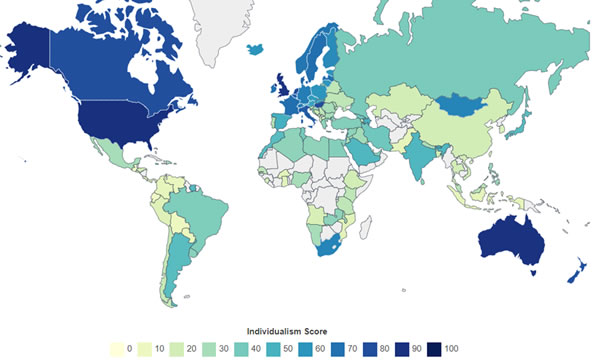
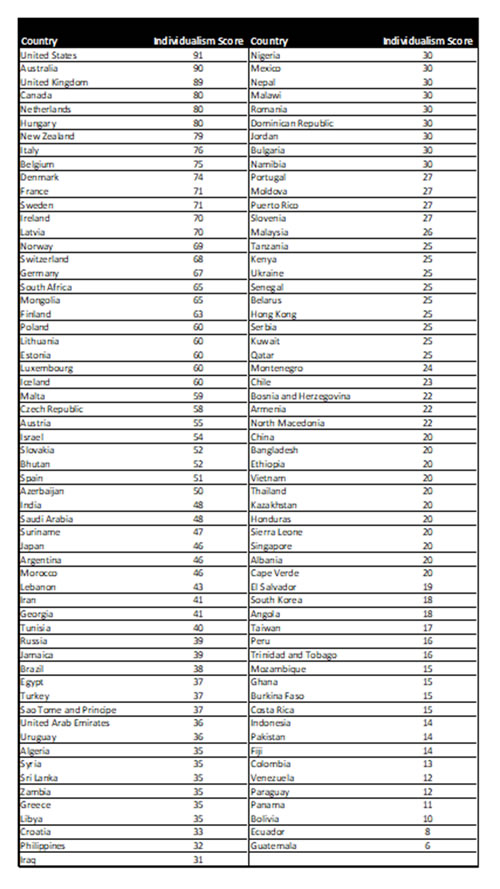
It is helpful to compare the individualism or collectivism ranking of the offshore location with that of the headquarters country. Countries with a high rating on individualism, such as the United States, Australia, United Kingdom, France, Belgium, Italy, and Canada, are focused on the rights and concerns of each person. Countries with low ratings on individualism, such as China, Japan, South Korea, Guatemala and Ecuador, stress the importance of the community—or collectivism.
In a country with a high individualism score, employees will benefit from individual performance ratings and incentive plans based on individual achievements. Employees in a collectivism country (low ranking on individualism) may be more comfortable with team ratings and team-based incentive plans.
When implementing global incentive plans, employees from a collectivist country may benefit from additional coaching and training to ensure employees and management understand the culture of the organization.
Individualist leadership will create total reward programs that recognize the unique contributions of the individual employees in the workplace. Collectivist leadership will emphasize the interests of the entire company rather than individual interests. In actual practice, organization will need to apply both individualist and collectivist practices to be successful.
2024 Individualism Ranking by Country