
Looking to Benchmark Pay?
Output and Time
The measure of distribution does not have to be output or time. The two can more reasonably be viewed as two ends of a continuum on which various compensation programs can be placed. At the time extreme is a system of automatic rate adjustment. At the other end is a piece-rate system, which pays a set amount for each unit produced. Other systems fall at various places in between. This continuum is illustrated in the figure below.
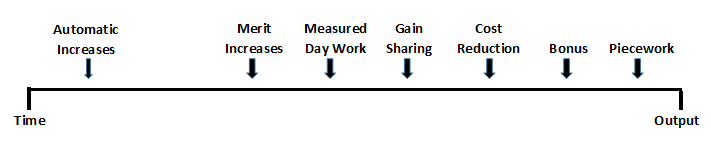
So where should a manufacturing pay program be along this scale? This is a matter of a number of factors:
- nature of work
- expectations
- technology
- cost
Nature of Work
The work itself is a major factor in determining whether to pay for time or output. The work characteristics to consider include:
- measurability of output
- the relationship between effort and output
- the degree of standardization
- requirements for quality as well as quantity
- competitive conditions, which make it imperative that unit labor costs be known and established before production
Expectations
General expectations are also important. Employee attitudes and expectations affect attempts to implement any incentive plan and greatly influence any chance of success.
Technology
Technological considerations may be a factor.
To the degree that production equipment sets the pace for the work, the employee loses control over determining the number of units that will be produced. The ability to change output through increased effort is critical in incentive pay plans. Also, variable pay plans are more likely to succeed in industries with stable technology rather than in those undergoing continual technological change.
Cost
Payment by results and payment by time have different effects on the organization's cost structure:
- Payment by results leads to variable labor costs, since they attach directly to output.
- Payment by time makes labor costs fixed, since they are the same in any period, regardless of output.
Our model of the employment exchange specifies that contributions lead to rewards.
In what unit should performance be determined?
| Time | Output |
|---|---|
| Payment on the basis of time allows for the inclusion of a large number of unspecified contributions. | Payment for output requires that contributions produce measurable results before they are recognized as contributions. |
In practice, production incentive pay plans often turn out to be payment for a single contribution – effort. Other organization-required contributions are often ignored.
Final Decision
The decision to pay for output instead of time in a manufacturing environment is partly based upon the rational factors just discussed and is partly a matter of faith. If an organization is convinced that incentives are the way to go, then a way will be found to apply incentives to the work that is performed.
Memory Jogger
Incentive pay plans are more likely to be successful in manufacturing businesses: