
Looking to Benchmark Pay?
Salary Survey Data Utilization
We have reviewed what survey sources are available, how to conduct your own survey, and how to report survey data. We can now examine how this data is used.
Most salary surveys are used to develop the annual base salary structure or compensation plan. Frequently, they are used to price individual jobs for new hires, existing employees, or even conduct a departmental market review.
Surveys can also be utilized to calculate salary increase budgets and even salary structure adjustments. Many times, surveys are utilized to assess and resolve compensation issues.
Developing a Market Summary from a Salary Survey
A compilation of a Market Summary is the starting point of developing a Compensation Plan. It includes the analysis and retrieval of salary survey data for recording into a Market Summary.
Useful Market Summary guidelines:
- Record the data consistent with your Compensation Strategy
- Age the salary survey data
- Delete outlying market data when appropriate
- Compute the averages
- Weight the data if needed
- Observe central data tendencies
- Be cautious and avoid being influenced by incumbent pay data
- Critique market trends throughout the process
Market Summary Example
A Market Summary should be prepared for each benchmark job in the organization which can be matched to the external salary surveys. The table below is an example of a simplified Market Summary:
Job Title: Accountant 2Data Aged to July 1, 2023
| Survey | Survey Effective Date |
Match | Market Rate | Aged Market Rate |
Weighting | Weighting Market Rate |
|---|---|---|---|---|---|---|
| ERI | 1/1/2023 | = | $80,619 | $82,231 | 75% | $61,637 |
| Survey 2 | 1/1/2023 | = | $76,015 | $82,231 | 25% | $19,384 |
| Market Avearage | $81,057 | |||||
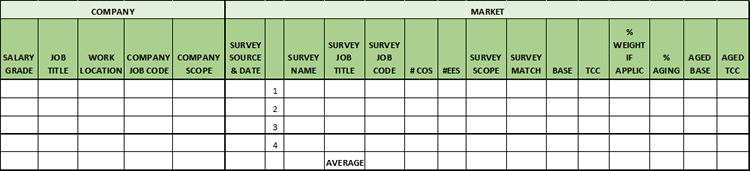
Below is an expanded version of the Market Summary in Excel that a company may use with specific fields for collecting and analyzing salary survey data:
Steps for Developing a Market Priced Salary Structure
Once the market summary has been completed, the following steps should be taken to develop a salary structure:
- Create a summary by job title of the aged base salary and aged total compensation market averages. Include the salary grade if previously graded.
- Ensure the summary is in low-to-high or high-to-low order by base salary market average or salary grade if previously graded.
- Group similarly paid jobs together to be managed within the same salary grade.
-
Develop a salary structure based on the market data for the benchmark jobs.
The salary structure may be calculated using a manual approach, an Excel Rate formula,
or regression analysis.
- Average base salary rate per grade
- % difference (progression) between grades
- Calculate salary range midpoints while ensuring a smooth % progression between grades and market competitiveness
- Calculate range minimums and maximums
- Another approach to consider is pure market pricing. Pure market pricing has been gaining popularity, and each job’s pay range is based on the actual market value of the job. There may also be multiple ranges per grade.
- Once completed, slot the remaining non-benchmark jobs into the salary structure.
- Develop a compa-ratio report comparing the employees' pay to the midpoints of the recommended salary structure and related costs.
Memory Jogger
When developing a market priced salary structure, employees' pay is commonly compared to: