Information regarding sought-after jobs can be useful for labor economists, talent managers, workforce planners, and HR analysts. This type of knowledge can help understand the changing nature of work to anticipate and plan for future needs. Postings on job boards are one source of such information.
In addition to wage, cost-of-living, and job demand data, ERI gathers job posting information. While this database is rich with job titles, descriptions, wage, and location information, it is also organization specific and can be labor intensive to clean. A crucial step in the process is matching titles from job postings to a benchmark list, in this case, ERI jobs. To accomplish this, we utilize various large language model (LLM) and artificial intelligence (AI) tools, as well as human analysts.
For this report, 460,000 job posts from a 12-month period ranging from August 2024 to July 2025 were analyzed. In order to efficiently summarize the information, jobs were aggregated into SOC job categories at both the 2- and 3-digit level. For this analysis, 2-digit aggregations are referred to as job families, while 3-digit aggregations are referred to as job groups.
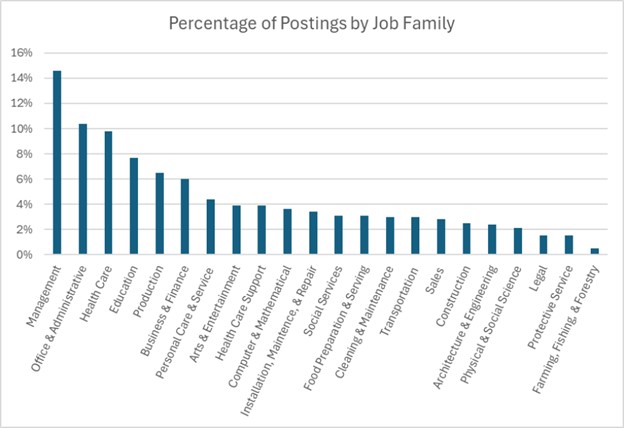
The analysis revealed a strong concentration of postings in five job families: Management, Administrative, Health Care, Education, and Production. As shown below, Management jobs dominated the postings, and the top five accounted for nearly 50% of all postings.
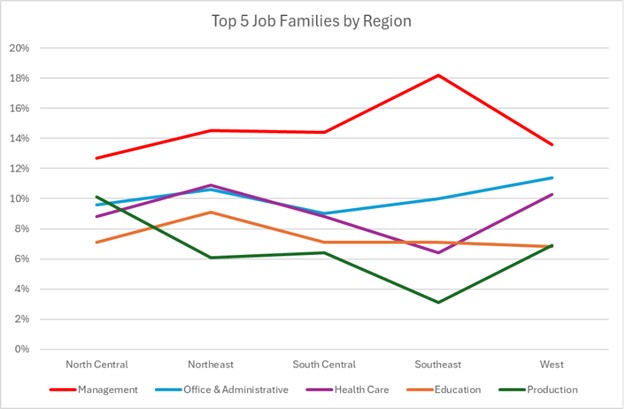
Looking at the top five job families by geography, we see some regional differences in the United States. In particular, the Southeast seems to deviate the most from other regions, with a higher concentration of Management postings and a lower proportion of Health Care and Production postings.
Looking at the 12-month job posting trend for the top five job families, they appear to remain relatively stable over time, with some having expected peaks and valleys (e.g., Education postings rising during the spring months).
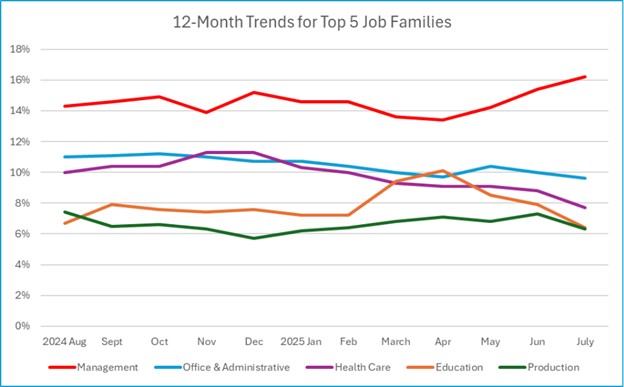
Although generally stable over time, jobs in Education, Health Care, and Management had the second, third, and fourth largest fluctuations, respectively, on average throughout the 12-month time span studied (bookended by Computer & Math and Architecture & Engineering jobs).
| Job Family | % Change |
| Computer & Mathematical | 3.9% |
| Education | 3.7% |
| Health Care | 3.6% |
| Management | 2.8% |
| Architecture & Engineering | 2.5% |
Turning to the job group (3-digit) analysis, seven of the top ten postings were, not surprisingly, members of the top five job families with the greatest increase in job postings. The remaining three were from different, distinct job families.
| Job Group | % Change |
| Service Managers | 6.9% |
| Health Care Diagnosing or Treating Practitioners | 5.6% |
| Operations Specialties Managers | 4.9% |
| Business Operations Specialists | 4.2% |
| Health Technologists and Technicians | 3.7% |
| Information and Record Clerks | 3.3% |
| Preschool, Elementary, Middle, Secondary, and Special Education Teachers | 3.3% |
| Computer Occupations | 3.1% |
| Counselors, Social Workers, and Community and Social Service Specialists | 2.8% |
| Personal Care and Recreation Workers | 2.6% |
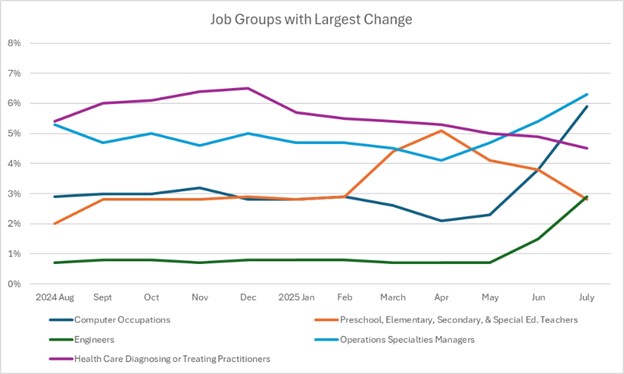
At the job group level, postings displayed lower fluctuations over time than the job family level. Computer Operations saw the largest change at 3.8%, while Health Care Diagnosing jobs were a modest 2.0%.
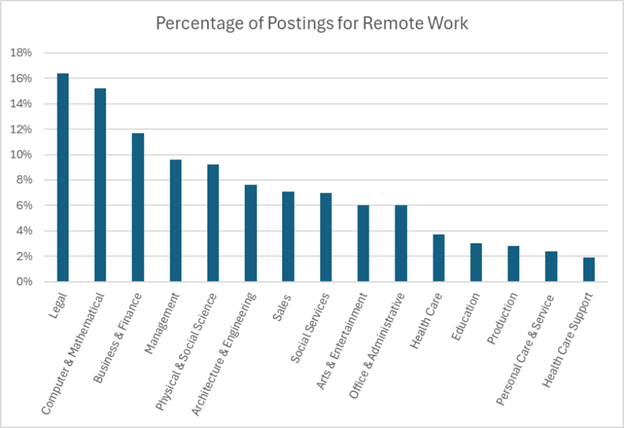
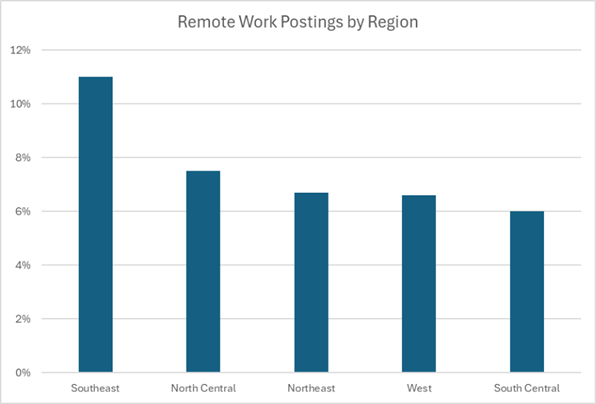
In addition to the summaries presented, we also looked at postings with remote work options. Remote work has become more common as technology has advanced and saw a large increase in 2020 due to the pandemic. Despite a return-to-work trend, there continues to be a modest demand for jobs with remote options. When looking at job postings, the most likely to include remote work were occupations in these fields: Legal, Computer & Mathematical, and Business & Finance. Interestingly, postings for jobs in the Southeast were much more likely to include remote work options compared to the rest of the country.
Taken together, these job postings suggest that the current labor market may be led by needs for leadership, essential services, and operational capacities. It is unclear at this time whether this job market trend will continue as we have experienced a slight uptick in unemployment and recent slowing in some job markets according to government job reports. Nevertheless, the overall diversity in types of jobs posted should be encouraging.