In a dynamic labor market, strategic salary planning is more important than ever. Effective compensation management, from design to communication and implementation, is key to attracting, retaining, and motivating employees. Compensation decisions must be made based on current, reliable, and accurate salary data in order to set pay that is both competitive and aligned with an organization’s budget. But how should an HR professional choose where to get accurate salary data? This blog considers some of the sources of salary survey data and what to consider in selecting a compensation data provider.
Comparing Compensation Data Sources
Free Government Data
The U.S. Bureau of Labor Statistics (BLS) provides datasets of publicly available economic and labor statistics data. The Occupational Employment and Wage Statistics (OEWS) program is a valuable free resource that produces employment and wage estimates annually for approximately 830 occupations. These estimates are available for the national average, individual states, and both metropolitan and non-metropolitan areas. National occupational estimates for specific industries are also available.
OEWS data are published annually, with one-third of the database updated each year, so these static wage estimates may not keep up with the latest market trends in a rapidly changing labor market. As OEWS estimates are often used to determine prevailing wage rates, the salaries reported tend to be conservative and may not be appropriate for organizations looking to set competitive pay rates to attract top-tier talent.
Crowd-Sourced Data
Thanks to the Internet, employees today have easy access to market compensation data for their jobs. Online survey data prepared for the masses is referred to as crowd-sourced data. As the sources are anonymous and the pay rates reported cannot be verified, free salary calculators using crowd-sourced data are not necessarily reliable. Salary estimates from this source tend to underestimate actual market values. Employees visit crowd-sourced data sites to determine if they are being paid appropriately, and it appears that a large portion of these employees are paid below average.
Employees raising issues with their employers over their compensation have become increasingly common. In fact, many companies now ask employees to submit an outline of their research and methodology used before they can make an argument that they are underpaid. Free online salary calculators using crowd-sourced data rarely make their methodologies available, leaving you with few answers about data collection and validation methods. So be cautious and keep in mind that these crowd-sourced data providers may also receive revenue from the sale of advertising. They typically have a broad customer base, and integrity of data may not be their highest priority.
Professional or Trade Association Surveys
Numerous trade and professional associations conduct annual salary and benefits surveys that are made available to their members. These surveys can be valuable as they capture compensation trends in relevant industries and geographic markets, helping member organizations benchmark pay against their peers.
A major concern when comparing compensation surveys is whether the job titles and their matching descriptions surveyed adequately mirror each other. Key positions included in surveys, known as benchmark jobs, should meet these requirements:
- Represent the entirety of relevant jobs
- Exist in the majority of surveyed firms
- Be readily definable
- Have similar descriptions to one another
- Represent quality reference points (concerning difficulty and responsibility) within the job structure
- Be widely recognized within the Human Resources community
- Be positions that at least some organizations fill using external sources
Use of trade and professional association surveys requires careful attention to job matching. This involves determining a close match between benchmark job descriptions used in a survey and an analyst’s knowledge of a similar position’s tasks within the organization. Knowledge of internal jobs is achieved via position analyses, the process of collecting detailed information about your internal jobs to ensure that descriptions accurately represent the work performed. So, if you rely on numerous surveys, expect this to be a labor-intensive process. Luckily, ERI’s Occupational Assessor includes a module devoted to position analysis using the Position Analysis Questionnaire (PAQ) and various references to guide you through the process. ERI’s Assessor Platform also includes easy job matching tools to correlate your internal jobs with benchmark jobs in ERI’s database, relieving you of much of this time-consuming process.
Industry and Job Function Salary Surveys
Salary surveys can be specific to an industry or a major job function, with specialized surveys reporting on employee benefits or salary increase budgeting, for example. ERI publishes compensation and benefits survey reports for the United States and Canada. Numerous industry-specific and job function surveys are published annually with data from for-profit and nonprofit organizations. Participating organizations include national, regional, and local companies that vary in size from very small to extremely large in terms of revenue. To participate in or purchase any of ERI’s industry, job function, or other specialized surveys, visit www.erieri.com/surveys. With a broad array of surveys available, ERI can meet the unique needs of your organization.
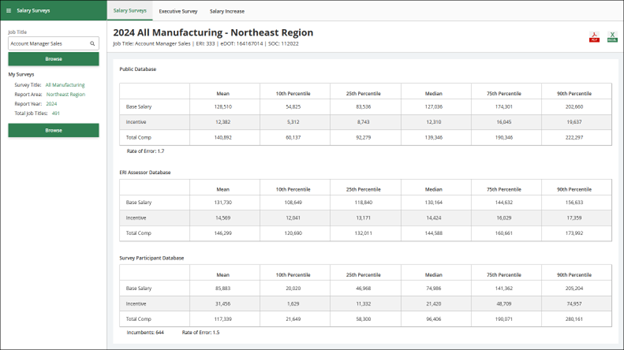
Due to potential antitrust violations regarding the exchange of salary information, it is important that U.S. salary surveys follow Safe Harbor Guidelines handed down by the Federal Trade Commission (FTC) and the Department of Justice. Under these guidelines, look for salary surveys that comply with these requirements:
- Conducted and managed by a neutral third party, such as a consulting firm, trade association, or survey provider
- Use participant data that is more than three months old
- Have at least five participants for each market-priced job, with no one company representing more than 25% of a statistic
- Ensure participant confidentiality through the use of summarized information
ERI’s industry and job function surveys comply with all Safe Harbor Guidelines, giving you the peace of mind you need when selecting a compensation survey provider.
Online Salary Survey Databases
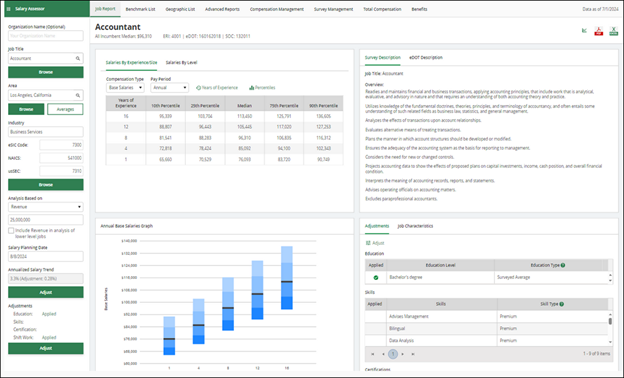
Salary survey databases are typically very robust and include high quality data. ERI’s Assessor Platform is a perfect example, with extensive databases including data from thousands of available salary surveys. Our employer-reported compensation survey database consists of benefits and compensation surveys vetted by our data scientists to ensure maximum accuracy. You can run unlimited salary reports with extensive data for 39,000+ jobs in 1,100+ industries and 10,500+ global locations. The platform makes it easy to customize compensation analyses based on experience, level, or organization size (revenue, assets, fiscal year budget, or organization size), while accounting for premiums based on skills, education, shift work, and certifications (including security clearances). Subscribers can not only accurately benchmark base salaries, incentives, long-term incentives, and total cash compensation at various percentiles, but also manage complex compensation plans and administer benefits using total rewards statements. The salary survey database is updated at least twice each quarter and includes consensus results from the most reliable survey sources.
Survey Management
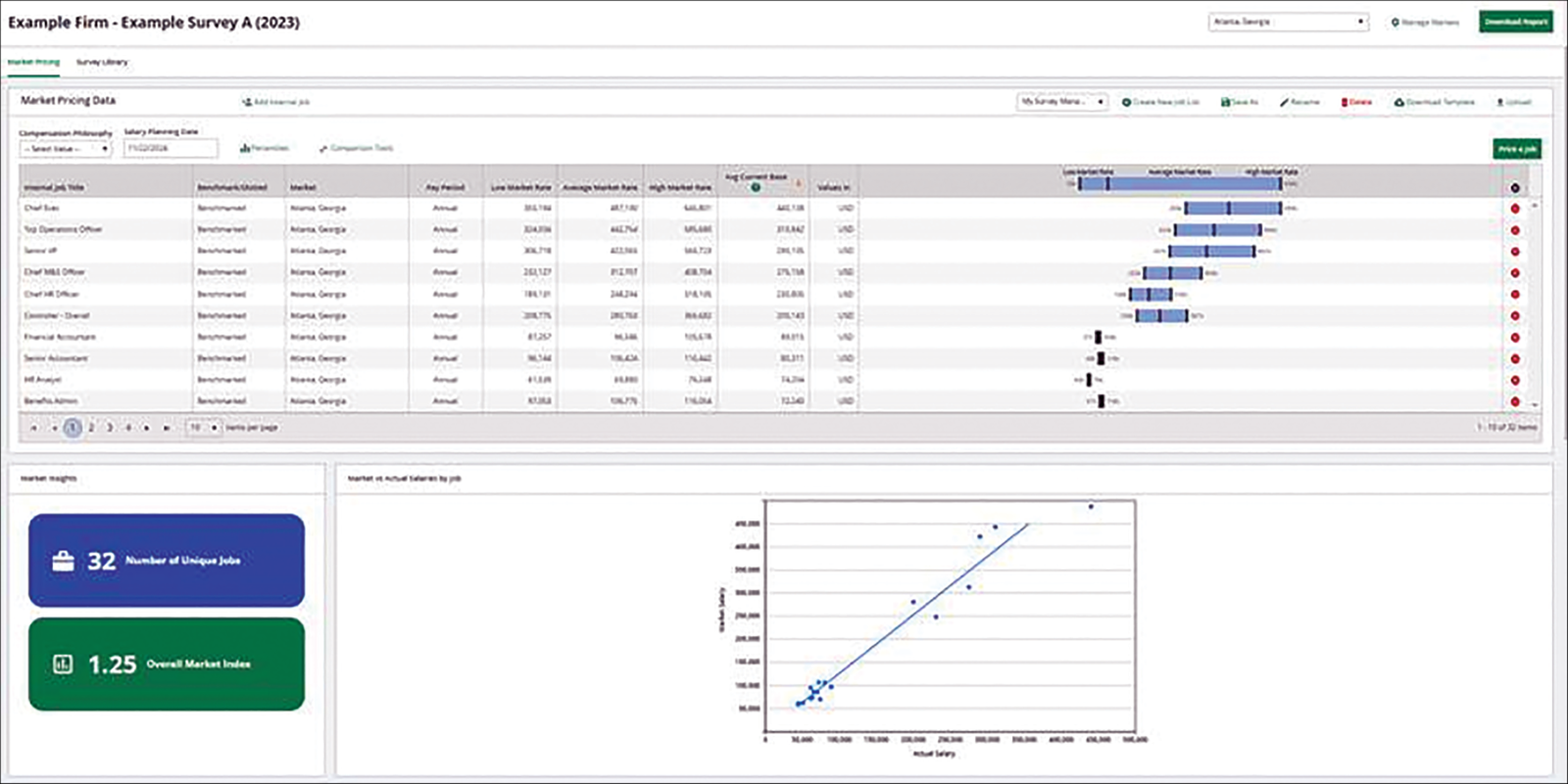
For those interested in using third-party salary surveys alongside an online salary survey database – combining the best of both worlds – turn to ERI’s Survey Management solution to compare ERI Assessor Series data with data from your various third-party surveys. It includes a customizable survey library to easily import and classify external surveys, apply premiums or discounts to selected survey data, and manage geographic survey markets. You can effortlessly organize, classify, and match internal jobs to your salary survey library. The Survey Management solution also features job-level market pricing tools, including benchmarking, slotting, market adjustment, and market strategy tools. Utilize market comparison tools, such as compression check, peer analysis, and variance from market, to identify and fix problems with structures. You can quickly export your customized survey analyses using a variety of report options. To learn more, schedule a guided tour of our Assessor Platform.
Conclusion
Identifying and selecting a compensation data provider requires paying close attention to the accuracy and reliability of the salary survey source. Competitive market salary data should reflect comparable organizations in terms of size, relevant industries, and appropriate labor markets targeting your peers. Check that your salary survey includes similar jobs ascertained via position analysis and careful job matching. Consider the sample size of the dataset, knowing that a larger sample size generally equates to more reliable data. As compensation trends change rapidly, verify that salary data are current and updated frequently. Understand the methodology used to collect and analyze the data, evaluating both the data collection and validation methods used. Reputable compensation data providers, such as ERI Economic Research Institute, should make these criteria transparent, providing accurate data you can trust.