Geographic Salary Differentials and Salary Level FAQs

New Geographic Assessor users are often surprised to find that geographic pay differentials are not constant across salary levels.  This post is a compilation of a few questions that are often posed on this topic and includes some specific practical advice in the answers.

Sometimes analysts are looking for a single number to describe the labor cost differential between two locations.  So, the first question is simply, “Why do the differentials vary by salary level?

When the original research was done for the Geographic Assessor by ERI’s founder over 30 years ago, it was quickly determined that there was more than one labor market operating in geographic locations.  This occurs for several reasons, with a major reason being that supply and demand for labor can vary at different salary levels.  For example, we may observe a surplus in labor in lower-paid jobs, and that surplus cannot be used to directly fill demand in professional or management-level positions. 

There could be a large difference in supply and demand in these various structures in a location due to driving economic factors.  Since labor is not interchangeable in these structures, it creates separate labor markets that can be subject to different levels of supply and demand, resulting in various pay differentials at distinct salary levels, even in the same geographic location.

The original analysis for the Geographic Assessor was run using nonexempt, exempt and management-level salary structures separately, and the results were seamlessly connected.  Even within the structures, patterns were observed indicating that the pay differentials varied by salary level and not simply by overall salary structure.  The Geographic Assessor was built so that users could identify and use this additional information by inputting both locations and salary level(s) to obtain a relevant, precise salary differential.  Over time, this approach has been used to capture various specific situations, such as increasing local minimum wages that can affect one end of the salary range but have no impact on the other end.

As we collect and process additional new data, we have increased the underlying structures from three to eight by further segmenting each of the original structures.  However, these details work predominately behind the scenes; the Geographic Assessor still operates by inputting the locations and salary level(s) of interest to report the corresponding pay differentials by location.

Given that pay differentials vary by salary level, one follow-up question is, “What is the best salary level to use?

The Geographic Assessor takes the approach that, since each planning situation may be different, there is no single “one size fits all” answer to this question.  Part of the tool’s flexibility is its ability to provide salary differentials across a wide range of salaries, rather than ERI researchers determining a single level that is best for all situations. 

There are some strategies that can help answer this question for specific situations.  If you are not using a geographic salary structure and just want a single percentage for each location, then using the average salary for the base location is a good starting point.  For example, using the United States average as the base location, the average salary in the US is currently around $65,000.  That is a reasonable starting point for that analysis. 

If you are working on a specific structure, then another approach might be to look at a salary toward the middle of the range in that structure.  This minimizes the “distance” between the chosen salary and all the other salaries in the range.  Some companies only have relatively high salaries in their structure, so the program gives them the ability to focus on a higher salary level than that of a company with only lower-paid positions in the structure.  If the structure is broad, then a more complex approach might be to measure differentials at more than one salary point and perhaps combine them, weighting if appropriate.

A final question discussed here is, “What location should be used as the base location?

If you are adjusting a structure to various destinations or are adjusting for remote worker pay, then it is relevant to consider the location used to build the base structure itself.  Often, this is either the headquarters location or the US average, depending on the source data of the original structure.  So, matching the location of the source data can help identify a starting point for the base location.  The differentials are always relative to the base location, so this is an important factor in the analysis.

One final point is that companies often repeat the analysis to be able to capture movement in the labor markets over time since labor markets are not static and do fluctuate.  If the results can vary at a single point in time just by changing the salary level (as described in the first question) or using a different base location as the benchmark (as described in the last question), then it often makes sense to keep these factors constant overtime to limit movement in the differentials to local labor cost changes. 

Careful consideration of these factors at the outset is a good idea.  This is not always possible when users inherit analyses from predecessors who may not have clearly documented the original logic of why these choices were made.  In this case, it is useful to understand the implications of changing them, even if the original rationale is no longer available.

Clearly, these are brief answers to questions that, in practice, can end up being quite complex.  While ERI does not provide any consulting services, we are a source of information – both in terms of data and data-driven tools, but also general guidance on questions like these.  In addition to geographic differential data collection and research, we conduct surveys on how companies implement geographic differentials in practice.  If you need additional information on any of the topics introduced here, please contact us.
Williston Employment Patterns and the Price of Oil

Williston, North Dakota, has been the center of the oil boom associated with the Bakken Shale formation for a number of years.  Tracking the change in employment of this town provides an interesting study in the timing and development of the boom and may give us some insight into near-term employment changes given the recent drop in oil prices.

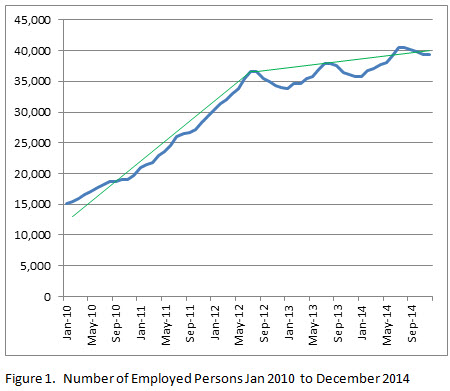
The number of employed persons in January of 2010 was 15,000 and, as of December 2014, there were about 40,000 employed persons in Williams County, North Dakota (per BLS LAUS data) – see Figure 1.  Looking at the monthly numbers, the rate of increase was fairly constant with the addition of just over 700 jobs per month for 32 months.  However, in the summer of 2012, the employment pattern changed completely.  The rate dropped to an average of 131 additional net jobs per month.  A clear seasonal pattern emerges as employment dropped during the winter and rebounded with that small net increase in the summer.  The green trend line in Figure 1 helps to highlight this shift.

Clearly Williston did not have the initial labor market to support a sudden increase in oil field exploration and development and quickly added employed persons.   The employment numbers suggest that the increase in development slowed in early 2012 and shifted to seasonal with ongoing production work holding steady.

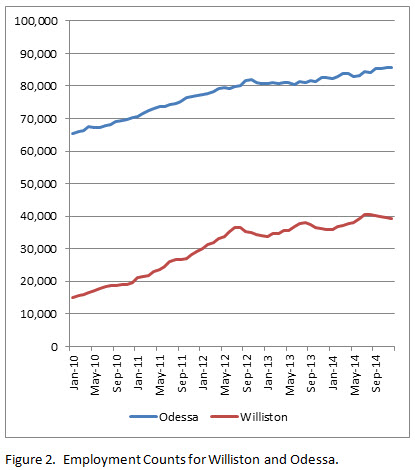
This pattern may lead one to wonder if it is unique to North Dakota; that is, did the recent discovery and development of this particular field drive the employment patterns we are observing?   To look at this more closely, consider Odessa, Texas, another area experiencing an oil boom in a different part of the country.  Figure 2 shows a similar pattern and timing of increase and subsequent flattening of the employment rate in Odessa as compared to Williston.  Odessa, being in Texas, doesn’t show the seasonality that Williston does and Odessa was a larger city to begin with, so the percentage of increase is not as large.  But the overall patterns are very similar.

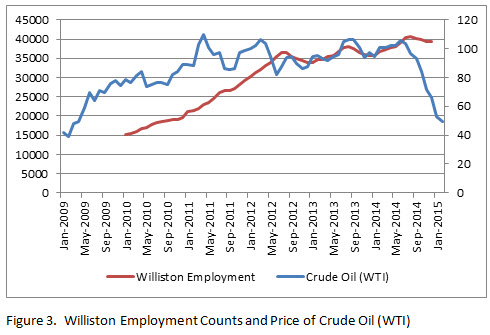
This suggests that it was not a factor unique to Williston that is driving the pattern, but an effect of the overall oil market itself.  To look at this in more detail, the employment numbers for Williston were overlaid with the price of a barrel of crude oil (WTI) including the prior year and four latest months.  It is beyond the scope of this analysis to investigate this relationship in detail; however, the graph shows that, once the price hits between $70 and $80/barrel, the employment numbers start the initial increase and, as oil continues up over $100/barrel, the rate continues with no seasonality.  Then, as the oil price increases slow, the employment rates in Williston flatten and take on the seasonal pattern about six months later.

While this is only an initial analysis of the oil boom phenomena, we can conclude that there is a relationship between the price of oil crossing about $70/barrel and employment pattern changes in the oil-driven economies of Williston and, to some extent, Odessa.  Currently the price at less than $70 is back to where it was nearly 6 years ago (before the boom), and all current indicators suggest it will stay below that level for at least the near term (update: the price is down to $50.96/barrel as of February 10, 2015).  The question the graph cannot address at this time is where do the employment numbers go from here?   We will be keeping an eye on these numbers to update as data become available.

Technically Speaking… Does Excel Always Know What is Best For Your Compensation Data?

The use of Microsoft Excel in the business compensation environment for performing quick and easy calculations has become ubiquitous, making the need to cite usage statistics pretty much meaningless. I often cut and paste data into a spreadsheet for some quick compensation data analyses, even when I have much more powerful statistical software packages at my disposal.

It was during one of these exercises that something odd in my Excel spreadsheet jumped out at me. I was reviewing a long list of salaries for Non-Profit Executive Directors, focusing on the 10th percentile, and the values reported by Excel were, in my opinion, well, illogical.

So, I tried an experiment comparing the results from Excel 2007 to my “powerful” statistics software (SAS 9.2). I then discovered the SAS software has five different algorithms for calculating percentiles, while Excel presents a single result.

Rather than start with a long list of salaries, I started small. I went to the Internet and grabbed the first 35 numbers in the Fibonacci Sequence. I ranked them in order and just took a guess at what the 10th percentile might be.

With 35 numbers, N/10 = 3.5, and I came up with two guesses at the 10th percentile; either the 4th number in the sequence (which is 2) or, if interpolated, halfway between the 3rd and 4th numbers (which is 1.5). I decided my best answer would be 2.

Let’s take a look at the actual results.

All five SAS results fall in line with my original guesses (between 1.5 and 2). However, Excel reports the percentile falling nearly halfway between the 4th and 5th numbers – the difference is up to 60% in this example!

What is going on? Well, Wikipedia[1] notes that Excel uses an “alternate” method to calculate percentiles. While these numbers are small, just a 0.9 difference, think about it in terms of salary planning. Multiply these numbers by $10,000, and now that 10th percentile is off by an amazing $9,000!

Conclusions? Well, first, I will be very cautious using Excel to calculate percentiles. The fact that this discrepancy was obvious in a list of actual salaries does lead me to recommend when analyzing important data using Excel, take the time to ensure the results make sense. Attributing a $9,000 discrepancy to Excel’s quirky percentile algorithm may not get you very far.

Of broader concern is that Excel doesn’t provide any information in Help, or elsewhere, letting me know what choices it is making for me in regard to my data. I had assumed that it just knew what was best and, by not giving me any choices or even documenting the option it uses, I had no reason to question its authority. Now I do.

1 Wikipedia – Percentile. Retrieved 6 June, 2011 from http://en.wikipedia.org/wiki/Percentile