Arising out of necessity in the COVID-19 pandemic, flexible work models have become commonplace worldwide. Many organizations across various industry sectors now recognize that flexible work arrangements yield both high performance and productivity as much as an in-office environment. Not only that, but many employers are adopting hybrid work models — in which employees are required to work a set number of days on-site but can work remotely other days — and remote work models — in which employees work exclusively from home or other off-site locations — as an effective tactic to appeal to job seekers and retain top talent.
According to a recent study conducted by Robert Half, 88% of employers provide some type of hybrid work option, with hybrid job postings growing from 15% in Q2 2023 to nearly a quarter (24%) of new jobs in Q2 2025.1 With trends such as these, flexible work arrangements are expected to remain a common option offered by many organizations.
Ultimately, hybrid and remote work have redefined traditional methods of compensation management, requiring HR teams to shift from traditional (in-office) to distributed (multi-geographic) workforce models. Because of this, compensation structures that are market-backed and equitable are at the core of an organization’s compensation strategy for a flexible workforce.
The Challenges of a Flexible Workforce
Setting pay policies has never been a simple task. With the rise of flexible workforces, HR and compensation specialists must consider the complexity and sensitivity of remote and hybrid compensation methods. While there are benefits to flexible work arrangements, it does not come without potential challenges, such as these:
Equity and fairness: Managing fair pay for a hybrid workforce can be complex. Imagine two employees who perform similar roles and are paid the same rate but work in different locations. Employee A works in-office in a high-cost urban area near company headquarters, while Employee B works remotely from a lower-cost area. Despite earning the same salary, these employees may have significantly different purchasing powers, potentially impacting morale and satisfaction. Alternatively, basing compensation on where the employee is located or performing their job using cost–of–labor differentials or location-specific salary data can still lead to a perception of unfairness if the differences in compensation are not communicated well. Often, striking the right balance requires transparency in pay methodology and consistent justification for pay rates.
Management and performance: Managers can find it difficult to communicate with remote workers, presenting a unique challenge in encouraging a collaborative work environment, in addition to providing feedback and training, especially to less experienced employees. Potential issues may also arise from misconceptions of reduced accountability and productivity as observing employee performance gets tricky.
Data and administration: Remote and hybrid work models may introduce more administrative demands, such as managing pay structures between different locations, tracking and adhering to pay regulations between locations, and setting appropriate benchmarks for remote roles by incorporating a mix of geographic market values.
HR and compensation professionals must tailor their approach to fit an individual organization’s unique compensation strategy and goals as there are various approaches to hybrid and remote salary planning.
Common Approaches to Compensation for Hybrid and Remote Workforces
As organizations adapt to hybrid and remote work, compensation models must evolve to balance fairness, competitiveness, and flexibility. Here are some approaches that HR and compensation experts may use to structure pay for distributed workforces:
Geographic Market-Based Pay: Many organizations consistently anchor pay to the geographic location of the employee or job-performed. For example, a software engineer in Austin might earn more than a counterpart in Lima due to higher regional pay norms in Austin. In this case, using geographic-specific salary survey benchmarks ensures that pay is equitable and defensible.
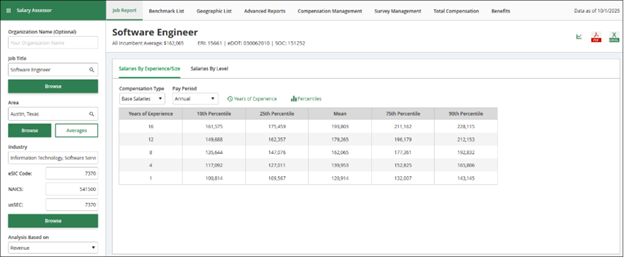
Figure 1. Use ERI’s Salary Assessor to benchmark pay for job titles in specific geographic locations, customizing analyses by industry, organization size, and more.
National Pay with Adjustments: In other cases, organizations may use an approach that combines national base pay rates with geographic adjustments to manage compensation for branch offices. For example, an organization might set a standard salary structure based on the nation of their headquarters, such as a company located in Los Angeles benchmarking pay against U.S. national average rates, and adjust pay for remote employees in specific locations based on the differences between the local labor market and the national average, treating them like branch offices. Implementation often involves the use of geographic differentials to determine different pay rates for the same job or salary level.
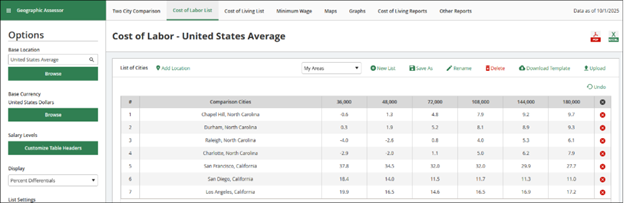
Figure 2. Use ERI’s Geographic Assessor to analyze geographic differentials for branch offices as compared to the U.S. national average.
Geographic Bands: Geographic banding is a common method that groups locations with similar labor costs into pay bands or tiers. Grouping similar locations together into a single band allows for simpler administration, while still matching relatively closely to local labor market conditions. For example, in ERI’s “Remote Worker Compensation Strategies” white paper, a possible scenario places any location with a cost–of-labor differential between 94.1 and 104.0 into Band 1. This band has a width of 10 centered on 100%. Compensation planners could also structure bands in different ways, such as placing a band of 10 in the 100-109 range or using bands of 5 in the ranges of 100-104 and 105-109. Once the number and ranges of bands are determined, administrators can assign differential adjustments to the bands. In this example, Band 1 might carry a 0% adjustment, Band 2 a +10% adjustment, and Band 3 a +20% adjustment, thus creating a simple and consistent framework for adjusting compensation by location.
Targeted Remote Acquisitions: As organizations adopt remote hiring, they gain access to a wider pool of talent. This might offer a particularly useful approach for talent acquisition of executives and individuals in technically-skilled roles. For example, AI-savvy and LLM/ML experts may receive additional premium pay due to the current high demand and limited supply of talent in this area. This makes regular benchmarking with ERI’s survey data essential, helping organizations identify where skill premiums are warranted and adjust pay accordingly to attract and retain top talent.
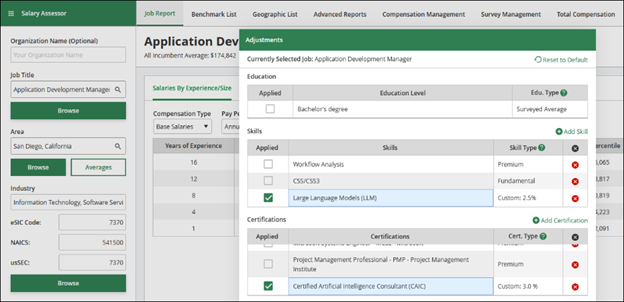
Figure 3. Use the Adjustments tool in ERI’s Salary Assessor to apply pay premiums for targeted Skills and Certifications.
Cost-of-Living Adjustments: Another less common approach entails viewing the remote worker as a relocated employee. This may require making a cost-of-living adjustment (COLA) to maintain the employee’s purchasing power in the remote location. Cost-of-living pay refers to an adjustment to help employees cover the rising costs of necessities, such as housing, food, and health care. Though compensation is generally determined by the cost of labor (based on the supply and demand of labor in a specific location and industry), a cost-of-living adjustment may be particularly helpful when managing relocations.
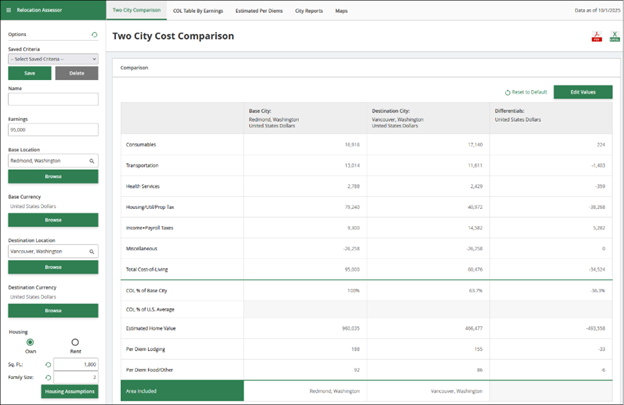
Figure 4. Use ERI’s Relocation Assessor to compare the cost of living in two or more locations based on earnings level, home size, home ownership or rental, family size, number and value of automobile(s), and other user inputs.
These are just a few approaches that HR and compensation professionals can employ to develop effective talent and compensation strategies for their hybrid and remote workforces. For a more detailed discussion of remote pay practices and trends, download ERI’s “Remote Worker Compensation Strategies” white paper.
Hybrid and Remote Workplace Trends
Despite the popularity of flexible work arrangements, ERI’s “Remote Work, AI, and Compensation Best Practices – Spring 2024” survey results white paper highlights a possible shift away from remote work in a post-COVID-19 world. According to ERI’s ongoing survey of remote work practices, 36% of respondents reported that, while they are hiring remote workers, it is only under certain circumstances. Additionally, in comparing Q2 to Q4 2024, there was a notable 10% increase in participating organizations reporting that they are not hiring remote workers but are hiring on-site employees instead.
ERI’s survey results demonstrate that, more than anything, compensation models are not a one-size-fits-all solution. As some organizations move away from an exclusively off-site remote work model towards flexible hybrid work options, ensuring that an organization’s compensation strategy is adaptable to ever-evolving work practices is crucial to maintaining equitable and competitive compensation.
Using Data to Drive Competitive Compensation
Effective hybrid and remote compensation design depends on leveraging accurate salary survey data and innovative compensation management technology, as provided in ERI’s Assessor Platform, the trusted solution for HR and compensation professionals.
Reliable data are the key to ensuring that an organization’s compensation decisions are fair, competitive, and defensible. For over 35 years, ERI has been focused on gathering salary survey data and researching pay to inform our compensation solutions, offering HR and compensation specialists vetted and validated data for salary planning. ERI’s platform houses a comprehensive database, helping subscribers easily access the current data that they need to set pay and manage compensation in specific markets.
Using ERI’s Assessor Platform, an essential resource for organizations of all shapes and sizes, subscribers can access accurate market data, optimize workflows, and manage complex compensation models to ensure that pay stays fair and competitive for hybrid and remote workplaces. From benchmarking pay in a specific market and analyzing geographic differentials to applying skill premiums and comparing the cost of living in multiple locations, ERI’s Assessor Platform has the data and resources that you need to successfully manage compensation for flexible workforces. See for yourself what makes ERI’s Assessor Platform a crucial resource in compensation management by trying a free demo today!
Source:
- “Remote Work Statistics and Trends for 2025.” Robert Half, 3 Sep, 2025, https://www.roberthalf.com/us/en/insights/research/remote-work-statistics-and-trends. Accessed 16 Oct, 2025.