For any organization, particularly those operating within a national or international scope, planning strategic geographic pay considerations is crucial to deciphering and developing the direction of an organization’s salary structure. As such, it becomes standard practice for HR and compensation professionals in these organizations to focus on and incorporate geographic pay differentials in their compensation planning and strategy.
With that said, this blog post will highlight a few of the findings from ERI’s Geographic Pay Differentials in Practice. This white paper draws conclusions from ERI’s Compensation Best Practices Survey, one of a series of surveys conducted by ERI as part of ongoing research in the field of compensation. ERI’s Geographic Pay Differentials in Practice white paper provides insights into common practices and current trends regarding how organizations analyze data to implement logical and competitive geographic pay differentials.
Consider these key insights:
- 81% of participating organizations factored in some sort of geographic pay differences when creating salary structures.
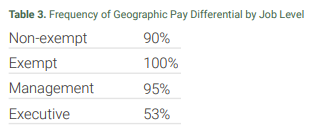
- Geographic differentials are typically applied to all job levels except executive.
- The two most popular geographic pay banding widths are 5% and 10%.
The findings discussed here shed light on popular trends and practices that may impact how HR and compensation coordinators incorporate geographic pay differentials into their own compensation planning.
Factors Involved in the Application of Geographic Pay Differentials
There are a multitude of factors involved in the application of geographic differentials. But, before we cover those factors, it is important to establish which data sources are used by organizations to inform those factors. As found in ERI’s Compensation Best Practices Survey, many organizations utilize geographic pay differential surveys and local salary survey data.
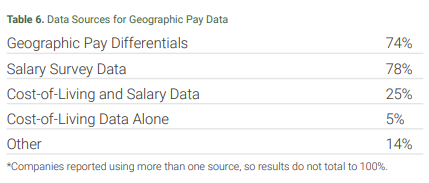
Interestingly, cost-of-living data are much less used, with only 5% of respondents reporting the use of cost-of-living data as their sole source. It is more common to utilize cost-of-living data in tandem with other sources, such as geographic salary data. Cost-of-living information is more typically used to build relocation packages, or apply cost-of-living adjustments, when moving employees. In contrast, geographic pay differences between offices in distinct locations are based more often on labor market cost differentials, which are measured by local salary surveys and reported by geographic labor cost differential surveys based on salary differences.
Size and Scope
A total of 158 organizations participated in ERI’s Compensation Best Practices Survey. Distinguishing characteristics of those participating organizations were that 63% of organizations had at least 500 employees and 69% were national or international in scope.
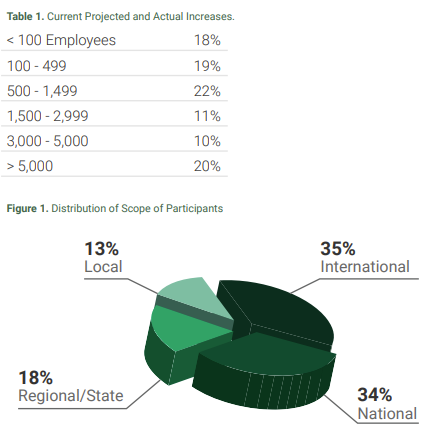
This demonstrates that the participating organizations were larger and broader in scope, asserting that smaller organizations, which may have only one location, are less likely to utilize and implement geographic pay differentials. Because organizations of a larger size and scope often work from a national or international scope, utilization of geographic pay differentials in compensation planning becomes crucial to informing and restructuring geographic salary structures for those organization. For instance, 81% of participating organizations factored in some sort of geographic pay differences when creating salary structures.
Job Level and Geographic Level
In the matter of geographic pay differentials, job levels are also a significant factor to consider as part of compensation planning. As found in ERI’s survey results, geographic differentials are consistently applied to all job levels except executive, where rates of application are almost half that of the other job levels. The table below demonstrates that executive-level jobs are often excluded from salary structures that are adjusted by location. Executives are usually recruited at the national level with compensation packages already so large and complex, making geography a minimal (if even existent) concern when planning executive compensation.
Additionally, defining the exact geographic level is another important aspect when applying geographic pay differentials, with a majority of organizations using either the city or metro level for geographic determination. Similarly, when it comes to organizations with a more international scope, these companies must maneuver specific complexities, often using city or metro geographies when applying geographic pay differentials. This is most likely done to account for multiple areas with significantly higher or lower cost of labor.
Administration of Geographic Pay Differentials
Now, how would HR and compensation coordinators put geographic pay differentials into practice?
Once the factors for geographic pay differentials have been applied, there are myriad ways to administer changes. According to the results of ERI’s Compensation Best Practices Survey, 56% of respondents reported that they would adjust the overall salary structure at an organization to implement geographic differentials, making this the most popular choice amongst HR and compensation coordinators.
These adjustments are made through geographic pay bands, typically reported as a percentage difference from a location. For instance, ERI’s findings in the chart below indicate that 80% of companies that report using geographic pay differentials will implement some type of banding and that the two most popular widths are 5% and 10%. When it comes to geographic banding, the widths can differ in line with specific factors, such as the variability between branch offices and the total number of branch offices.
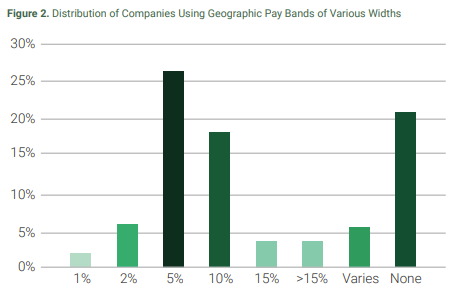
As mentioned, most survey respondents typically administer geographic pay differentials by adjusting the overall salary structure. Coordinators would typically use this approach because it addresses specific variations and practicalities, such as enabling coordinators to treat locations that might have minor differences consistently, having fewer numbers to work with, and allowing an easier handle of small fluctuations over time. Moreover, this method simplifies administration of geographic pay differentials while still matching relatively closely to local labor market conditions.
ERI’s Geographic Assessor Is the Reliable Choice
For practical applications of geographic differentials and more, ERI’s Geographic Assessor provides a robust tool to assess the cost of labor by geographic location, ensuring equitable pay across all branches of an organization. Our Geographic Assessor provides quintessential tools and trusted data to simplify essential tasks, such as calculating geographic differentials, building pay structures, and ongoing maintenance of an organization’s compensation program.
Try a free demo today to begin streamlining salary planning and compensation management in your organization!