
Looking to Benchmark Pay?
Point Factor Method – determining factor and sub-factor weighting
Now the factors and sub-factors need to be weighted because, in all likelihood, some are more important than others. There are 2 methods for assigning correct weights: by committee or statistically.
The committee approach. In this approach, a committee made up of members who are familiar with the jobs they are asked to review:
- carefully study factor, sub-factor, and level definitions
- individually rank the factors and sub-factors in order of importance
- reach agreement on each ranking
- individually distribute a weighting adding up to 100% among the factors
- reach agreement on each weighting
The result is a set of factor and sub-factor weights that reflect the judgment of organization members, which contributes to acceptance of the plan.
The next step is to assign points to the factors and sub-factors based on the established weightings. It is typical to use a total of 1,000 points.
A table can be produced showing the weightings and corresponding points. These weightings and points will be used to score all the applicable jobs in the organization.
Example Weighting Table
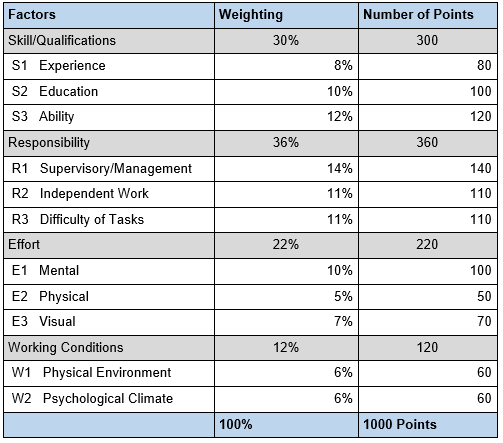
Once the factor and sub-factor weightings and points have been decided, the next step is to set levels for each sub-factor.
Set Levels
Levels may be established by either arithmetic or geometric progression.
| Arithmetic Progression | Geometric Progression |
|---|---|
| Increases are in equal numbers of points from the lowest to the highest level. This approach best supports pay equity. | Increases are by equal percentages. Point differences increase between each level starting at the lowest level. |
Set levels for each sub-factor. For example, the Ability category may be given five levels, 1 being low to 5 being high.
Distribute the points equally among the sub-factors’ levels. Ability has been assigned 120 points and 5 levels so the points must be distributed equally like this:

The lowest level is almost always assigned some points because it is usually assumed that all jobs include some of a factor. In the Ability example, perhaps 24 points for level one is deemed to be too high and should instead be 12 points. Then distribute the remaining 108 points with equal intervals among 4 levels.
Example: A committee decides that the total points possible in the plan are 1,000. So, a sub-factor weighted at 16% carries 160 points (0.16 x 1,000 = 160). If the sub-factor has 4 levels, the points assigned for level 3 would be 120 (160/4 = 40, 40 x 3 = 120).
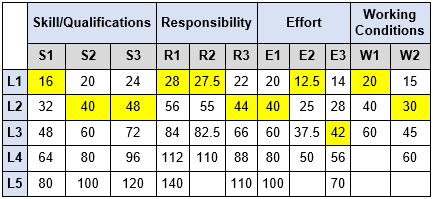
Table With Levels, Factors, and Sub-factors
The idea is to build a single table that can be used to score all the jobs in the organization.
Scoring a Job
An Accounts Payable Assistant job is scored in the table above for each sub-factor and appropriate level. (The points selected are for demonstration purposes only). The points are highlighted in yellow giving a total score for the job of 348.
When all jobs are scored, jobs with scores within given intervals are grouped together. There should be no gaps between intervals, and they should not overlap. Beginning with 1,000 total points, the organization decides that there should be 10 pay grades.
Since the total points for all Level 1 sub-factors is 219, Grade 1 will start at 200 with 800 points being distributed between 10 grades. The grades do not have to have exactly the same intervals but for this example will be distributed evenly. Higher grades may have wider intervals. (For a full treatment of grades and ranges see DLC course 81, Salary Structures and Pay Delivery.

So, the Accounts Payable Assistant job would be assigned to Grade 2.
Memory Jogger
You are designing a point-factor plan with a total of 500 points. One of the factors carries 25% of the factor weight. How many points may be distributed among the factor’s sub-factors?