
Looking to Benchmark Pay?
PREVENTING GENDER PAY DIFFERENTIALS
To truly eliminate the gender pay gap, you need to consider how to prevent those differentials from occurring in the first place.
We will review the steps you can take to eliminate gender discrimination in:
- job analysis
- job evaluation
- hiring and promotional practices
- pay for performance
Job Analysis
Job Analysis and job descriptions are the foundation of an organization's compensation plan and impact all aspects of human resources management and the organization's labor force. The accurate alignment of an organization's pay practices relies on accurate job analysis and job descriptions. This is a critical step to ensure fair and accurate job documentation to eliminate gender discrimination.
Job analysis includes the determination and reporting of all pertinent information about a job. Once data is collected and documented through job analysis, a completed job description is produced. The process requires reporting to be factual, concise, and precise. This ensures fair and accurate job documentation for job evaluation purposes and affects internal equity and appropriate organizational alignment — a critical step toward eliminating discriminatory pay practices.
The appropriate selection and training of job analysts throughout a company will influence fairness and equity in job documentation. It takes a special skill in job analysis to recognize when the use of elevated words might be skewing a job upward inappropriately to support a higher level. Both female and male job analysts should be used and display the following skills:
| Relate | Influence | Organization Knowledge | Empathy |
| Recognize Pertinent Information | Internal Equity | Non-Biased | Verbal/Written Communication Skills |
| Sincere/Neutral | Trust/Confidentiality | Fortitude/Credibility | Good Judgment |
Job Evaluation
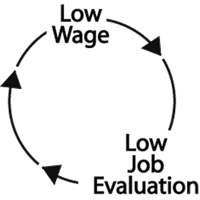
One study found that current wage rates unduly influence the job evaluation process. For example, female-dominated teaching roles versus male-dominated teaching roles. It creates a vicious circle.
An effective job evaluation plan will appropriately evaluate all jobs, regardless of male- or female-dominated roles, based on their skill, effort, responsibility, and working conditions.
Job evaluation is a formal and systematic process for determining the relative value of jobs in an organization based on job content. The end result of a formal job evaluation process will develop a job worth hierarchy for an organization. Selecting the right job evaluation program and managing the program fairly and equitably goes a long way towards resolving gender discrimination issues.
Remember: Always evaluate the job—not the person
There are five main types of job evaluation programs:
| Qualitative | Quantitative |
|---|---|
| Whole Job Ranking | Factor Comparison |
| Job Classification | Point Factor |
| Market Pricing | |
A quantitative method approach to job evaluation can aid in resolving pay discrimination issues. It is important though that one job evaluation plan be used throughout a company and:
- one approach should be used for all jobs
- the defined factors should be developed to fairly and equitably represent all jobs without bias
- the end result of the job evaluations are only as good as the evaluators of the jobs
A single job evaluation plan is commonly used for all jobs. When multiple job evaluation plans are used, compare the plans through the use of key jobs that can be evaluated in each plan to show if the results are the same in each job.
The job evaluation, which can be quantitative and non-quantitative, is defined as:
- A formal & systematic process for determining the relative value of jobs based on job content
- Complementary to market pricing
- Used to ensure internal consistency
The most common non-quantitative job evaluation methods are:
-
Whole Job Ranking – simplest form of job evaluation. Jobs are ranked from highest to lowest in importance. All you must do is identify the most important job, then identify the next most important job, and so on. Continue this process until all jobs are arranged in a hierarchy. This method works fine for small companies with few jobs but has also been used by some very large organizations.
Example President Vice President, Marketing Director, Production Senior Engineer Engineer Associate Engineer -
Job Classification – ranks jobs on a "whole-job" basis but includes guidelines to aid in classifying the jobs. This method is frequently used in the public sector.
Example Officer Chief Executive Officer Executive Vice President Director Director, Marketing Manager/Specialist Manager, Accounting Supervisor/Senior Professional Supervisor, Accounts Payable Professional Engineer Associate Professional Associate Engineer
The most common quantitative job evaluation methods are:
-
Factor Comparison – utilizes a set of compensable factors to determine the value of jobs. The value of the job is measured in monetary terms using subjective weighting for each of the compensable factors. The result is a standard pay rate per job which helps to create internal equity. The factor comparison methodology may be useful in a manufacturing business.
Example Hourly Rate Skill Effort Responsibility Working Conditions Manager $25.00 $12.50 $5.00 $5.00 $2.50 Supervisor $18.00 $9.00 $3.60 $3.60 $1.80 Senior Machine Operator $14.00 $7.00 $2.80 $2.80 $1.40 Machine Operator $12.00 $6.00 $2.40 $2.40 $1.20 Packager $10.00 $5.00 $2.00 $2.00 $1.00 -
Point Factor – the most prevalent of the quantitative methods. The point factor method of job evaluation uses defined factors to establish a job value. An
organization will typically select three to ten compensable factors by selecting what an organization values
for its jobs such as skill, effort, responsibility, and working conditions. Job points are allocated for
each factor based on the appropriate level and then added together for a total score.
Korn Ferry is a popular point factor job evaluation plan extensively used in the private and public sectors that evaluates jobs based on three or four worksheets:- Know How: The depth of technical/specialized knowledge and breadth of managerial knowledge to perform a job.
- Problem Solving: The original, self-starting thinking required to identify, define and resolve problems.
- Accountability: The measured effect on end results.
- Working Conditions: Optional chart measuring working conditions such as physical environment, hazards, manual effort, and mental concentration.
| Example Korn Ferry Evaluation | Know-How | Problem Solving | Accountability | Working Conditions | Total Points | Profile |
|---|---|---|---|---|---|---|
| Accountant | EI2 200 |
E3(38) 76 |
E1C 87 |
363 |
55-21-24 |
Legal Support for the Korn Ferry Guide Chart®- Profile Method of Job Evaluation.
- The Korn Ferry Method can be a useful tool in meeting a global employer's legal and regulatory challenges. The Korn Ferry Guide Chart-Profile Method of Job Evaluation is gender neutral and has not been found to be discriminatory or unlawful in any reported legal decision. The method's factors have also been widely accepted as a basis for setting fair and equitable pay practices and are compliant with the U.S. Equal Pay Act of 1963 and Canadian provincial pay equity legislation, which refers to job-to-job comparisons based on "skill, effort, and responsibility." The method has been court-tested time and again and has proven to be legally defensible since its inception. Working conditions such as physical environment, hazards, manual effort, and mental concentration can also be added to account for job-context factors. However, many of these factors, unlike the three other factors used in the example, can be potentially discriminatory, so there needs to be a compliant process to design and utilize supplementary factors alongside the Guide Charts. The Korn Ferry Method is the job evaluation method of choice for many public and private employers, mainly because of the strong belief that it will serve them best if legal challenges arise.
Market Pricing - process by which the value of each job in an organization is determined through the analysis of the external marketplace as typically reported through salary surveys. This is easily the most prevalent method of job evaluation today. It can supplement other types of internal job evaluation programs as well.
Selecting the correct benchmark jobs to market price for setting a salary structure can also help to avoid discriminatory issues. Avoiding low-paid, female dominated jobs as benchmarks can be an excellent approach toward taking steps in eliminating the gender pay gap.
For a more complete treatment of Job Evaluation, see DLC course 34, Using Job Evaluation in Your Organization
Memory Jogger
The Point Factor methodology is an example of: