
Looking to Benchmark Pay?
Step 4: Compare male and female wages in all categories.
To look for gender pay differentials, we suggest the following approaches.
Outliers Analysis: This analysis focuses on pay grades and examines the very high and very low employees in each group to determine if they fall predominately into either the male or female group.
Median Analysis: The first level of statistical analysis is Median Analysis. This can be done by arraying the salaries of all employees in the chosen category(s) and arranging them in ascending or descending order. The middle salary is the median. The median is particularly useful as it is not influenced by one or more extreme salaries.
Medians that are substantially different for male and female employees within the category need to be examined to see what explains the difference. Not all differences are discrimination; some may result from differences in justifiable factors such as performance levels.
Mean Analysis: The second level of statistical analysis is calculating the average or arithmetic mean. The mean provides the average, in this case, of a series of wages. The means for the male and female employees can be compared using advanced statistical processes.
Multiple Regression Analysis: Having two means that are statistically different indicates that there may be discrimination. What is needed is a technique that can explain the nature of the differential. This is the role of regression analysis.
Regression analysis looks at all or selected factors that your company uses to set wages and regresses these against the array of salaries for a category. If these factors explain the variance, then there is presumed to be no discrimination. However, if these factors do not explain the variation, then on the basis of residual analysis it is presumed that discrimination is present.
Example: There are studies indicating that women and other minority groups earn less than white males of equivalent age, experience, and education. This problem can be studied within the organization by developing a regression equation of the salaries of males based upon their:
- age
- experience
- education
- any other relevant characteristics
Then use this equation to predict female salaries. This prediction can then be compared with women's actual salaries. The results might look like the figure below.
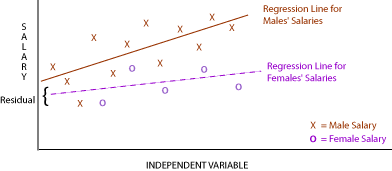
Predicted and Actual Salaries
Source: M. W. Gray and E. L. Scott, A 'Statistical' Remedy for Statistically Identified Discrimination, in Academe, May 1980, p. 177.
For complete information on how to perform this type of analysis, see DLC Course 49: Regression Analysis Used in Compensation Administration.
Step 5: Conduct a comparable worth study.
Remember, according to the Equal Pay Act, the only acceptable criteria for wage differences are:
- job content
- performance on the job
- qualifications such as education/training/experience
If you find that pay differentials are present in your organization and cannot be attributed to legally defensible factors, you will then need to make a comparable worth study on your organizations jobs.
This means conducting job evaluation in order to rank the vulnerable or questionable jobs in your organization, thereby determining which have equal worth to the company. Evaluate the skill, effort, responsibility and working conditions of different jobs - see DLC Course 34: Using Job Evaluation in Your Organization
Step 6: Establish a new pay policy line.
After the job evaluation is complete, plot only male-dominated jobs (or if your organization is small, all the jobs held by men) on the pay policy line in the current pay structure. Then, using the job evaluation scores to identify comparable jobs, set the female jobs' pay based upon the pay of comparable male jobs. To find out more about setting pay policy lines, see DLC Course 82: Creating a Market Competitive Salary Structure.
Memory Jogger
The best way to reduce gender pay discrimination in the wage structure is to have: