
Looking to Benchmark Pay?
Internal equity
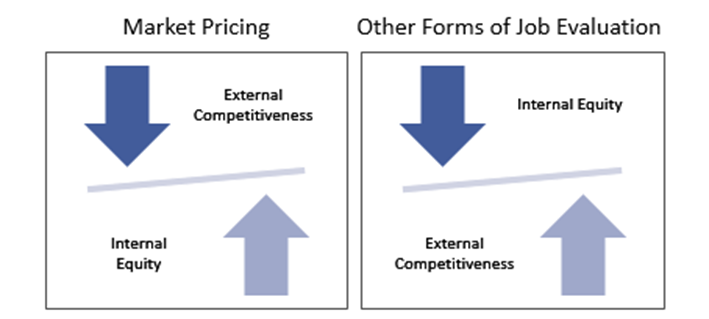
Job evaluation performs a critical role in determining the job hierarchy of an organization. When performed well, internal equity is achieved but requires continual maintenance due to new and revised jobs. In new economy organizations, job evaluation is most frequently attained through market pricing of jobs. Market pricing and external competitiveness is traditionally measured first, and then internal equity is determined second. But in traditional organizations, fairness in pay and internal equity are focal points in compensation decisions, with job evaluation plans such as ranking, factor comparison or point factor plans existing solely to ensure fairness.
Today, pay equity legislation requires increased attention to internal equity. In fact, there is a growing trend toward increased used of point factor plans for measurement of skill, effort, responsibility, and working conditions.
Cost-benefit efficiency
Compliance requirements affect compensation practices, making certain types of compensation less expensive than others. Examples of this are seen in the U.S. rules relating to equity compensation and employee stock ownership plans (ESOPs). Lower salary levels, higher variable pay opportunities, and use of stock awards translate into more cost-effective use of compensation dollars in new economy organizations. In addition to cash conserving approaches, equity compensation (i.e., stock options, restricted stock units), and pay–for–performance are approaches to compensation used by many new economy organizations.
Tax considerations
Today’s complex tax codes place increased emphasis on tax effective compensation in both employee and executive compensation.
Capital accumulation
A primary goal of several total rewards elements is employees accumulating capital through participation in the long-term success of the company as if they were owners/shareholders. Capital accumulation was initially a targeted concern only for management, but this has changed. New economy organizations, such as Facebook, Google and Facebook have equity awards plans for both management and non-management staff.
Many employees will trade higher salaries at secure and stable organizations for equity in start-up and high-growth organizations. As these equity programs require employees to stay with a company for a set number of years before vesting (receiving full ownership of the stocks), these programs increase talent retention. These equity plans have, in many cases, created millionaires. However, these plans have also proved a false promise for employees of the many start-up firms that have failed.
Social concern
Some total rewards elements are offered to employees because employers consider social concerns in their decision making, such as leave of abscense programs, long–term disability plans, long-term care plans, work-at-home arrangements, and work–life balance flexible scheduling.
Compliance
Legal requirements continue to increase in our current environment. Where previously state and federal law were key to governing HR practices, today city, county, state, federal, and even international laws may need to betaken into account. Organizations today also regard total rewards plans as a tool to improve talent inflow and talent retention due to increasing global competition, though laws pertaining to labor, executive compensation, equal pay, pay equity, minimum pay, retirement plans, data privacy and reporting, and other rules and regulations must still be considered. The complex compliance framework of the plans has also contributed to Human Resources working more closely with Legal, Finance, and Accounting to balance the need for more simple and transparent total rewards programs. To review U.S. Federal laws and regulations regarding compensation, see DLC Course 15: Federal Employment Laws That Impact Compensation and Benefits.
Matching goals
Total rewards plans depend on the way an organization prioritizes its objectives. Typically, two or more objectives can be in conflict, making it difficult to achieved them in a single plan. Because no two organizations have exactly the same goals, there are unique combinations of total rewards elements.
Communication
Organizations today place greater emphasis on human resources strategies to effectively compete in the "war for talent" and talent retention. This is reflected in turnover statistics and total rewards plans focused on capital accumulation. Sophisticated online dashboards can help management observe and act on key business objectives. Because information access is available via online technologies to many employees both at the office and from their homes, organizations can share information that otherwise might only be distributed, except on an as "requested basis." This allows new-economy organizations to communicate both their plans and objectives more frequently and transparently. See DLC Course 02: Technology in Total Rewards.
Memory Jogger
In new-economy organizations, what is the most common form of job evaluation?