
Looking to Benchmark Pay?
Working Capital
Working capital for inventory purposes is a reasonable need. This is a major reason for any company that’s producing a product to retain earnings.
The most prevalent approach to determine the working capital needs of a company is to review the operating cycle. Let's take a look...
| Operating cycle | The average time interval between the acquisition of materials or services entering the company and the final realization of cash. |
The operating cycle normally consists of 2 cycles:
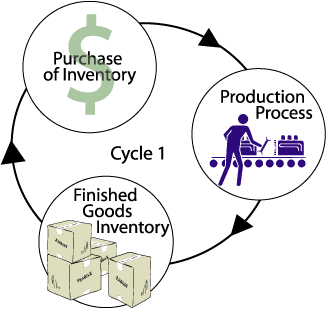
Cycle 1. Purchase of inventory ---> production process ---> finished goods inventory
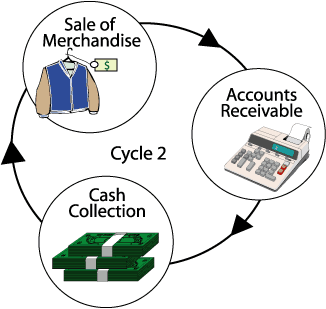
Cycle 2. Sale of merchandise ---> accounts receivable ---> cash collection (a.k.a. Order-To-Cash "OTC")
Bardahl Formula
A standard calculation, the Bardahl Formula was established for the systematic operating cycle as a result of the case, Bardahl Manufacturing Corporation v. Commissioner (July 23, 1965). The Bardahl formula may be used to find the reasonable working capital needs of a corporation for AET purposes:
Inventory cycle = average inventory/cost of goods sold
PLUS
Accounts receivable cycle = average accounts receivable/net sales
MINUS
Accounts payable cycle = average accounts payable/purchases
EQUALS
Average Operating Cycle
Bardahl Formula Example
Assume ABC Distributing Co. is in the process of being sold. The operating cycle for this type of business is the time neeed to convert inventory into sales and accounts receivable, and any accounts receivable into cash. When purchasing inventory, the company benefits by using "other people's money" in the form of trade accounts payable. The average inventory amount is $850,000 and the total cost of goods sold is $5,030,000. The average accounts receivable are $800,000 and the net sales is equal to $7,500,000. Finally, the average accounts payable equals $470,000 and the amount of purchases equals a value of $5,050,000. What is the average operating cycle of this company (as a percentage)?
| One-Year Average Operating Cycle | |||
| Inventory Cycle: | |||
| Inventory | $850,000 | 16.9% | |
| Cost of Goods Sold | $5,030,000 | ||
| Accounts Receivable Cycle: | |||
| Accounts Receivable | $800,000 | 10.7% | |
| Seller's Net Sales | $7,500,000 | ||
| Accounts Payable (Credit) Cycle: | |||
| Accounts Payable | $470,000 | (9.3%) | |
| Seller's Purchases | $5,050,000 | _______________ | |
| Average Operating Cycle (% of a Year) | 18.3% | ||
The end product of the formula, the average operating cycle, is multiplied by the cost of goods sold plus adjusted operating expenses to arrive at reasonable working capital.
Average Operating Cycle x (Cost of Goods Sold + Adjusted Operating Expenses) = Reasonable Working Capital
This formula assumes a yearly computation of working capital needs. This may not be realistic for some industries. Companies in markets that are highly cyclical during the year need to use a time period of less than one year. Also, the Bardahl Formula works best for manufacturing companies.
Note: There is an argument in this formula for keeping accounts payable under control. The higher the accounts payable, the lower the computed working capital needs, and the more likely that a tax liability will be incurred.
Memory Jogger
The Bardahl formula was developed to allow a company to: