
Looking to Benchmark Pay?
Golden parachutes
The golden parachute (often referred to as an executive severance package) is another type of nonqualified deferred compensation plan commonly offered to executives or key employees. A golden parachute is an arrangement between the employer and certain key employees whereby the employer commits to pay agreed upon amounts to these key employees if there is ever a change in the management control of the organization.
Golden parachutes provide pay and benefits to executives after termination due to a merger or acquisition.
Golden parachutes serve 2 purposes:
- Recruiting and retention tool for executives. In this regard, a golden parachute is change-of-control insurance. It is an agreement that if there is a takeover and the executive is terminated, they will receive monetary and other benefits in excess of their customary compensation.
- Poison Pill. Golden parachutes can involve substantial monetary rewards and benefits, and the acquiring organization is on the hook for them, adding to their costs of acquisition – thus the poison pill.
Golden parachutes are not very popular with some people:
- stockholders who want an acquisition to go through
- critics of inflated executive compensation
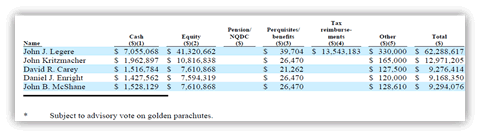
A sample disclosure of a Golden Parachute in a Proxy filing from the Global Crossing and L3 Communications Merger (Note the $13M+ in tax reimbursements for CEO John Legere) is shown below: :
How much? Section 4999 of Internal Revenue Code 280(G) was established in 1983 to discourage excessive change-in-control parachute payments made to executives who are defined as "disqualified individuals." Payments that equal or exceed three times the recipients average “base amount” for the prior five years, and are a golden parachute, are considered excessive severance payments by the IRS and trigger a 20% excise tax in addition to any other taxes that may be owed. Also, the excess payments are not deductible to the company.
Disqualified Individuals are employees of the organization who are officers, shareholders, or highly compensated individuals.
A highly compensated individual is in the top 1% of earners in the organization or, if less, one of the highest paid 250 employees of the corporation.
Q: What is the base amount?
A: The disqualified individual's annual gross taxable compensation averaged over a five-year period
Q: What happens if this amount is exceeded?
A: For disqualified individuals whose total change-in-control (or golden parachute) payment exceeds 2.99 times the base amount:
- the executive is taxed an additional 20% excise tax for the amount that exceeds the base amount.
- the excise tax is not deductible for income tax purposes by the recipient
- the excess payments are subject to Social Security tax
This excise tax has a significant negative side effect. It is based on the executive's base amount. If that amount is low, then the excise tax quickly takes effect. Some companies specify that the severance payment will be capped or adjusted to not exceed 2.99 the base amount.
In addition to Golden Parachutes there are other types of severance plans:
- Silver and Tin Parachutes. These plans extend the concept to a broad range of employees in the organization, usually at smaller amounts than the 2.99 base amount threshold.
- Pension Parachutes. Pension parachutes increase retirement benefits to employees participating in the employer's defined benefit plan. Pension parachutes are activated only after a change of control, resulting in the automatic termination of the company's retirement plan. The excess assets are then used to provide additional benefits for all active and retired participants.
- Standard Severance Policy. This policy includes severance payments for rank-and-file employees. The payments kick in if a hostile takeover costs employees their jobs. Many people see these plans as an even better takeover defense than golden parachutes since having greater numbers can add up to a larger total package, even if individual payments are less.
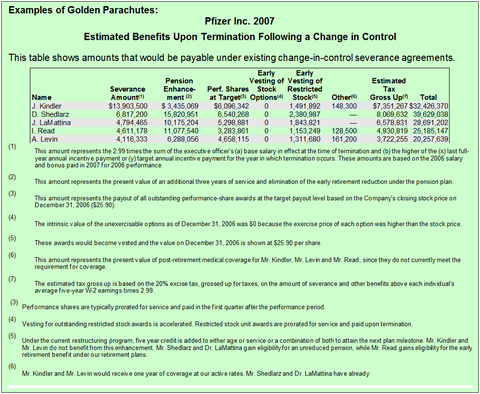
Exercise Question
One major purpose of golden parachute programs is to: